Mesothelioma and Asbestos Risk for Hospital Workers

Many older hospitals contain asbestos in boilers, HVAC systems and more. When disturbed, asbestos can become airborne. While anyone in hospitals can be exposed, hospital maintenance workers may face higher risks. People diagnosed with mesothelioma may have legal options for compensation.
Learn About Occupational Asbestos Exposure in Our Free Guide Free 2026 Mesothelioma Guide
How Are Hospital Workers Exposed to Asbestos?
Like many buildings in the 20th century, hospitals were constructed using asbestos. Asbestos is a durable, flexible, fire-resistant mineral. It was commonly used in insulation, drywall, tiling and more. Hospitals were no exception.
Hospital workers often came into contact with asbestos materials while doing many of their job duties. Maintenance workers who interacted with hospital machinery and insulation were particularly at risk of asbestos exposure. Exposure can cause conditions like mesothelioma to develop.
- More than 22 million healthcare workers in the United States (2024)
- Asbestos Exposure: Previous and low ongoing exposure risk
- Asbestos-Related Disease Risk: Moderate
- Related Occupations: Boiler workers, electricians, plumbers
In the 1970s, new regulations started to limit asbestos usage. But previous uses of asbestos are still present in many buildings today. Asbestos exposure poses greater risks in smaller spaces without ventilation. This is often how hospital boiler and maintenance rooms were constructed. These rooms are commonly in basements without windows, increasing the risks of asbestos exposure.
What Asbestos Products Put Hospital Workers at Risk?
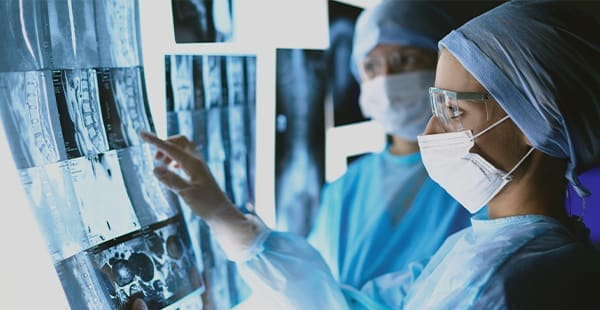
Hospital workers who had to interact with asbestos materials were most at risk. For example, many maintenance workers had to fix machinery and pipes that contained asbestos insulation. But some workers who merely spent time around these materials were exposed, too. In one case, a radiographer who examined X-rays in a basement with asbestos pipes contracted mesothelioma.
Hospital workers may have been exposed to asbestos from:
- Ceiling and floor tiles
- Cooling towers
- Drywall
- Electrical wiring insulation
- HVAC duct insulation
- Lab equipment
- Pipe insulation
Hospitals did not manufacture asbestos products. But many were built with asbestos construction products or with equipment that contained asbestos. The companies that made those products may be responsible for exposing workers to the dangerous mineral. Victims of their asbestos use can seek compensation through lawsuits, asbestos trust funds, VA benefits and other legal claims.
Common Places Hospital Workers May Find Asbestos
Asbestos was most commonly used in rooms that had to withstand high temperatures. Areas with machinery and plumbing, for example, often contained asbestos.
Common workplace areas where hospital workers faced asbestos exposure include:
- Boiler rooms
- Break rooms
- Crawl spaces
- Equipment rooms
- Mechanical rooms
- Patient care areas
It is unknown how many hospitals were built with asbestos products. One survey in the United Kingdom found that two-thirds of hospitals in London and Scotland contained asbestos. There has not been a similar study in the United States. But given the widespread asbestos use of the 20th century, it’s likely to be in many older U.S. hospitals.
A few confirmed hospitals containing asbestos include:
- General Hospital in Cincinnati, Ohio
- Mercy Hospital in Cincinnati, Ohio
- St. Francis Hospital in Cincinnati, Ohio
- St. Joseph’s Hospital in Syracuse, New York
- St. Mary’s Hospital in Rochester, New York
Some hospital workers faced a higher risk of asbestos exposure than others. However, no level of asbestos exposure is safe. In one case, even a hospital office administrator developed mesothelioma due to asbestos exposure.
Hospital Workers and At-Risk Trades
Hospital workers encompass many different occupations. Some worked around asbestos products consistently. For example, HVAC workers may have encountered asbestos tape in ductwork. But anyone in a building containing asbestos may face the risk of exposure.
At-risk trades in the hospital industry include:
- Carpenters
- Construction workers
- Electricians
- Engineers
- Health workers
- HVAC workers
- Lab workers
- Maintenance workers
- Microbiologists
- Office workers
- Plumbers
- Radiographers
- Radiologists
- Speech pathologists
Many hospitals have on-site laboratories with various types of lab equipment. Older lab equipment may have contained asbestos, which can be released as materials wear down. Lab workers using this equipment may face an increased risk of asbestos exposure.
People who work in hospitals with asbestos materials could also unknowingly bring the fibers home on their clothing. This can lead to secondary exposure for their friends and family.

- Don't lose your rights
- Free case evaluation

- Help filing VA claims
- Treatment for Vets
- Provide for loved ones
- $30 billion set aside
Mesothelioma Risk for Hospital Workers
Asbestos use in hospitals puts its workers at risk of developing mesothelioma. A U.S. study of 748 mesothelioma patients found that 2.9% were hospital workers. Another 4% were ambulatory healthcare workers. Using a different industry classification system, 4.8% of patients worked in healthcare roles.
Healthcare was also found to be one of the top professions for women who developed mesothelioma. This is notable, as women tend to face significantly fewer occupational exposure risks than men.
If you developed an asbestos illness from working in a hospital, you may have compensation options. You can talk to an experienced mesothelioma lawyer about your next steps.
Sources
ABC News. Former workers develop mesothelioma after asbestos exposure at Australian hospitals.
Centers for Disease Control and Prevention. About Healthcare Workers.
Gao Y, Mazurek JM, Li Y, Blackley D, Weissman DN, Burton SV, et al. Industry, occupation, and exposure history of mesothelioma patients in the U.S. National Mesothelioma Virtual Bank, 2006-2022. Environ Res. 2023 Aug 1;230:115085.
Los Angeles Times. Worker Blows Whistle on Asbestos in Hospital.
OSHAcademy. 184 Healthcare: Asbestos Safety.
SHP. Two thirds of hospitals contain asbestos – report finds.
Financial Assistance for Mesothelioma Patients

Tara Strand specializes in writing content about mesothelioma and asbestos. She focuses on topics like mesothelioma awareness, research, treatment, asbestos trust funds and other advocacy efforts.

 Legally
Reviewed by
Jennifer Lucarelli
Mesothelioma Lawyer and Legal Advisor
Legally
Reviewed by
Jennifer Lucarelli
Mesothelioma Lawyer and Legal Advisor
For more than two decades, Jennifer Lucarelli has served as Legal Advisor at Mesothelioma.com. She has advocated for more than 1,000 asbestos victims, securing millions in settlements and helping them access quality medical care.