National Gypsum Company

National Gypsum Company manufactured building materials, including joint compounds and cements, containing asbestos. After growing asbestos litigation led to its bankruptcy, the NGC Bodily Injury Trust was created in 2003 to compensate eligible asbestos victims.
Learn About Asbestos Trust Funds in Our Free Guide

National Gypsum History of Asbestos Use
National Gypsum, also known as National Gypsum Company or NGC, was founded in 1925 and remains in business today. The company’s primary focus began with gypsum wallboard. They claimed that their wallboard was lighter, more flexible and higher performing than any other wallboard brand, even stamping their products with a “Gold Bond,” offering $5,000 to anyone who could prove otherwise. Their Gold Bond strategy was trademarked by 1926 and became an alternative brand name for their products.
National Gypsum continued to thrive throughout the next few decades, successfully navigating several patent-infringement lawsuits and emerging from the Great Depression. The asbestos company continued to expand its product line and acquired several other large companies to grow its presence and set of resources.
- Abestone Corporation
- Allentown Portland Cement Company
- America Encaustic Tile
- Atlantic Gypsum
- Huron Portland Cement Company
- Keene’s Cement
- Murray Tile
- National Mortar and Supply Company
- The Austin Company
- Universal Gypsum
- Wesco
- Windsor Paper Mills Inc.
Universal Gypsum was one of the largest and most important acquisitions, as the company was one of their main competitors and twice the size of NGC. National Gypsum Company gained gypsum plants in Texas, Iowa, Pennsylvania and New York, along with several other mines and a strong presence in the Midwest. Though NGC did experience some losses, particularly during the Great Depression, they continued to borrow and raise money, exchange stocks and strategically target different products to maintain their role as a major construction product supplier.

- Don't lose your rights
- Free case evaluation

- Help filing VA claims
- Treatment for Vets
- Provide for loved ones
- $30 billion set aside
National Gypsum Asbestos Trust Fund
National Gypsum faced thousands of asbestos-related bodily injury and property damage lawsuits. In 1985, the company joined the Wellington Agreement, which established the Asbestos Claims Facility (ACF) to coordinate the defense and settlement of asbestos personal injury claims.
As asbestos lawsuits continued to increase, National Gypsum filed for Chapter 11 bankruptcy in 1990. During the reorganization, the original company was renamed Asbestos Claims Management (ACMC) to handle its asbestos liabilities. The reorganized National Gypsum continued manufacturing and selling its products.
The bankruptcy plan also created the NGC Settlement Trust, an asbestos trust fund established to compensate asbestos victims. However, the trust did not have enough funds to pay the growing number of claims.
In 2002, ACMC filed for Chapter 11 bankruptcy a second time. This led to the creation of the NGC Bodily Injury Trust in 2003, which continues to pay current and future asbestos claims using a payment percentage system to preserve funds.
If you or a loved one were exposed to National Gypsum asbestos products and believe you are entitled to compensation, learn how a mesothelioma lawyer can help.
Most Recent Information From the NGC Bodily Injury Trust
The trust’s year-end 2025 report indicated that, as of December 31, 2025:
- The National Gypsum Asbestos Trust paid more than $10.67 million to asbestos victims.
- Approximately $198.7 million in total assets remain in the trust.
Current National Gypsum Asbestos Trust Payment Percentage
The current payment percentage is 45% for the NGC Bodily Injury Trust. The scheduled value for a National Gypsum Expedited Review mesothelioma claim is $45,000. At a payment percentage of 45%, the current payout on a National Gypsum mesothelioma claim filed under the Expedited Review is $20,250.
Determining Review Process When Filing a National Gypsum Asbestos Trust Claim
An experienced asbestos lawyer will evaluate the injured party’s case to determine the appropriate review process when submitting a National Gypsum Asbestos Trust claim.
A sample of National Gypsum asbestos claims filed between 2023 and 2025 indicated that approximately 3% of claims were filed through the Expedited Review (ER) process and approximately 97% of claims were filed through the Individual Review (IR) process.
- Expedited Review: Claims filed through the ER process are evaluated using the established medical and exposure criteria. If approved, payouts are based on the scheduled value for claimant’s disease level and the trust’s current payment percentage.
- Individual Review: Claims filed through the IR process receive a more detailed evaluation of the claimant’s medical records, asbestos exposure and other individual factors. This review may result in compensation that is higher or lower than the standard scheduled value. IR submission is required for certain lung cancer claims, secondary exposure claims and claims that do not meet the trust’s standard criteria.
The trust is currently accepting National Gypsum asbestos claims to compensate eligible victims with payouts determined by factors such as age, diagnosis, exposure history and the law firm’s asbestos settlement history.
National Gypsum Asbestos Products
Construction products produced from the 1920s – 1970s are known to have likely contained asbestos. The inexpensive mineral provided resistance to fire, chemicals and heat as well as durability, making it useful in building materials.
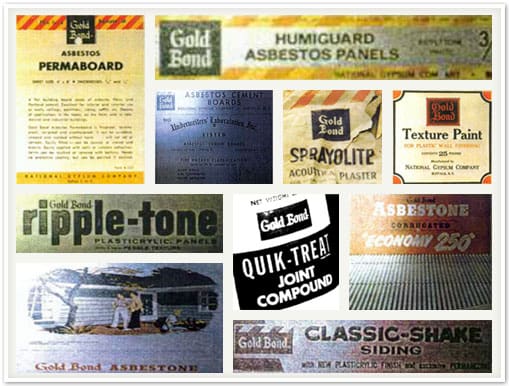
Specific brand-name products from National Gypsum that have been linked to asbestos include Gold Bond Gypsum Board, Gold Bond Abestone, Gold Bond Sprayolite, ProForm Drywall Finishing Products and PermaBase Cement Board. Many NGC asbestos products fall under the brand name Gold Bond, which was popular during the time when asbestos was most commonly used.
| Product Name | Start Year | End Year |
|---|---|---|
| National Gypsum 35 lb Asbestos Roofing Jacket | ||
| National Gypsum All Purpose Joint Cement | 1949 | 1973 |
| National Gypsum Asbestibel Panels | 1963 | 1981 |
| National Gypsum Asbesto-Grid Panels | 1958 | 1981 |
| National Gypsum Asbestone Roofing | ||
| National Gypsum Asbestos Cement Siding Shingles | 1953 | 1981 |
| National Gypsum Asbestos Cement Siding Shingles | 1953 | 1981 |
| National Gypsum Asbestos Fiber | ||
| National Gypsum Asbestos Jackets for Pipecovering | ||
| National Gypsum Asbestos Stripping Tape | 1944 | 1945 |
| National Gypsum Asbestos-Faced Mineral Wool Insulation Board | 1944 | 1945 |
| National Gypsum Chromashake Siding | 1954 | 1968 |
| National Gypsum Chromatex Siding | 1954 | 1968 |
| National Gypsum Chromatone Siding Shingles | 1954 | 1968 |
| National Gypsum Classic “32” Siding | 1954 | 1968 |
| National Gypsum Classic Shake Siding | 1954 | 1968 |
| National Gypsum Corrugated “400” Siding and Roofing Material | ||
| National Gypsum Craftco Cement Paint | ||
| National Gypsum Deeptex Siding | 1954 | 1968 |
| National Gypsum Drywall Laminating Adhesive | 1953 | 1956 |
| National Gypsum Dutch Lap Shingles | 1954 | 1968 |
| National Gypsum Gold Bond Acoustical Plaster | 1949 | 1968 |
| National Gypsum Gold Bond All Purpose Joint Compound | 1966 | 1973 |
| National Gypsum Gold Bond All-Purpose Joint Cement | ||
| National Gypsum Gold Bond Asbestone Panels | 1958 | 1981 |
| National Gypsum Gold Bond Asbestos Cement Board | ||
| National Gypsum Gold Bond Asbestos Faced Wool Mineral Board | 1944 | 1945 |
| National Gypsum Gold Bond Asbestos Fiber | ||
| National Gypsum Gold Bond Asbestos Paper | ||
| National Gypsum Gold Bond Ceiling Panels | 1958 | 1981 |
| National Gypsum Gold Bond Color Texture | 1936 | 1969 |
| National Gypsum Gold Bond Corrugated “Economy 250” Asbestos Cement Sheet | 1954 | 1981 |
| National Gypsum Gold Bond Cover Crete | 1949 | 1965 |
| National Gypsum Gold Bond Craftex | 1937 | 1937 |
| National Gypsum Gold Bond Crown Coat Cement | 1935 | 1976 |
| National Gypsum Gold Bond Decorite | 1937 | 1945 |
| National Gypsum Gold Bond Exterior Stucco | 1930 | 1949 |
| National Gypsum Gold Bond E-Z Spray Texture | 1971 | 1972 |
| National Gypsum Gold Bond E-Z Tex | 1937 | 1970 |
| National Gypsum Gold Bond Finisher | 1958 | 1960 |
| National Gypsum Gold Bond Fire-Shield Plaster | 1958 | 1970 |
| National Gypsum Gold Bond High Humidity Acoustical Plaster | 1952 | 1956 |
| National Gypsum Gold Bond Insulating Cement | ||
| National Gypsum Gold Bond Joint Compound | 1949 | 1973 |
| National Gypsum Gold Bond Macoustic Smooth Finish | 1935 | 1943 |
| National Gypsum Gold Bond Mortar Mix | 1959 | 1973 |
| National Gypsum Gold Bond No. 340 Insulating Cement | 1944 | 1946 |
| National Gypsum Gold Bond Patching Plaster | 1933 | 1950 |
| National Gypsum Gold Bond Perfo-Lyte Acoustical Plaster | 1955 | 1972 |
| National Gypsum Gold Bond Permaboard | 1954 | 1981 |
| National Gypsum Gold Bond Quick-Weld Compound | 1972 | 1974 |
| National Gypsum Gold Bond Quik-Treat Joint Compound | 1963 | 1974 |
| National Gypsum Gold Bond Ready Mixed Joint Cement | 1953 | 1976 |
| National Gypsum Gold Bond Ready Mixed Joint Compound | 1953 | 1976 |
| National Gypsum Gold Bond Rockwall Acoustic Plaster | ||
| National Gypsum Gold Bond Siding | ||
| National Gypsum Gold Bond Spackling Paste | 1962 | 1967 |
| National Gypsum Gold Bond Spray Quick | 1967 | 1972 |
| National Gypsum Gold Bond Spray Quick A | 1963 | 1964 |
| National Gypsum Gold Bond Sprayolite | 1956 | 1973 |
| National Gypsum Gold Bond Sprayolite | 1956 | 1973 |
| National Gypsum Gold Bond Sprayolite Acoustical Plaster | 1956 | 1968 |
| National Gypsum Gold Bond Spray-On Acoustical Plaster | 1955 | 1956 |
| National Gypsum Gold Bond Sta-Smooth Compound | 1968 | 1974 |
| National Gypsum Gold Bond Super Westex | 1952 | 1969 |
| National Gypsum Gold Bond Tar Paper | ||
| National Gypsum Gold Bond Texas Texture | 1946 | 1962 |
| National Gypsum Gold Bond Texture Paint | ||
| National Gypsum Gold Bond Thermo Weld Compound | 1972 | 1972 |
| National Gypsum Gold Bond Thermotec Asbestos Cement Sheets | 1960 | 1981 |
| National Gypsum Gold Bond Topping Cement | 1935 | 1976 |
| National Gypsum Gold Bond Topping Compound | 1958 | 1976 |
| National Gypsum Gold Bond Triple T. Compound | 1968 | 1976 |
| National Gypsum Gold Bond Tri-Treatment Joint Cement | 1957 | 1973 |
| National Gypsum Gold Bond Tri-Treatment Joint Compound | 1957 | 1973 |
| National Gypsum Gold Bond Two-in-One Joint Compound | 1968 | 1970 |
| National Gypsum Gold Bond Velvet Joint Compound | 1958 | 1975 |
| National Gypsum Gold Bond Velvet Texture A.R. | 1962 | 1967 |
| National Gypsum Gold Bond Velvet Topping Compound | 1958 | 1975 |
| National Gypsum Gold Bond Velvet White Super Spray | 1962 | 1967 |
| National Gypsum Gold Bond Vinyl Texture | 1963 | 1975 |
| National Gypsum Gold Bond Vinyl Topping Compound | 1964 | 1976 |
| National Gypsum Hexagonal Shingles | 1954 | 1965 |
| National Gypsum Humiguard Asbestos Panels | 1968 | 1981 |
| National Gypsum Laminating Adhesive A | 1970 | 1974 |
| National Gypsum Natcor | 1944 | 1946 |
| National Gypsum Panelectric Groove Fill | ||
| National Gypsum Perfect Spray | 1971 | 1972 |
| National Gypsum Perforated Panels | 1958 | 1981 |
| National Gypsum Plasticrylic Panels, aka Ripple Tone Panels | 1958 | 1981 |
| National Gypsum Pliaboard | 1954 | 1969 |
| National Gypsum Ranch-Style Shingles | 1956 | 1969 |
| National Gypsum Rockwall Acoustic Plaster | ||
| National Gypsum RockWool Insulating Cement | ||
| National Gypsum Soffit Panels | 1959 | 1981 |
| National Gypsum Sprayed “Limpet” Asbestos | 1945 | 1949 |
| National Gypsum Sussex “32” Siding | 1954 | 1968 |
| National Gypsum Thermacoustic | 1949 | 1961 |
| National Gypsum Thermo Weld Compound | 1972 | 1972 |
| National Gypsum Thermotec | 1960 | 1981 |
| National Gypsum Two-in-One Compound | 1968 | 1970 |
| National Gypsum Unperforated Panels | 1958 | 1981 |
| National Gypsum Wesco Joint Cement | 1952 | 1965 |
| National Gypsum Woodgrain Siding | 1954 | 1968 |
 Did You Know?
Mesothelioma victims may be eligible for compensation from more than one asbestos trust fund.
Filing a claim with one trust does not impact your eligibility for compensation from another trust fund.
Did You Know?
Mesothelioma victims may be eligible for compensation from more than one asbestos trust fund.
Filing a claim with one trust does not impact your eligibility for compensation from another trust fund.
National Gypsum and Occupational Exposure
As National Gypsum Company’s presence grew, so did the potential for asbestos exposure from its products. During World War II, NGC manufactured acoustic panels used on aircraft engines, metal landing strips and insulation for cargo ships, all of which were considered highly useful for the Korean and Vietnam wars. National Gypsum became a primary supplier of wallboard across the United States, even struggling to meet the growing demand.
With all of these major projects, asbestos products were exposing workers across various industries and trades. Whenever products were damaged, cut, trimmed, sanded, worn down or disturbed in any way, asbestos fibers could easily become airborne. Once airborne, asbestos fibers may be inhaled or ingested, putting individuals at risk of diseases such as malignant mesothelioma.
- Acoustical workers
- Cement masons
- Construction workers
- Contractors
- Drywall workers
- Insulation installers
- Pipefitters
- Plasterers
- Sheetrock hangers
National Gypsum was in control of 27% of the gypsum market by 1950 and was producing over 150 building materials during a time when construction was frequent. By the 1930s, the dangers of asbestos were acknowledged and safer alternatives were developed. However, asbestos was a much cheaper option and companies like National Gypsum did not cease asbestos production, continuing to benefit from growing profits. In 1950, NGC reported $75 million in sales.
Questions About Filing a Claim Against National Gypsum Company? Ask experienced mesothelioma advocate Jennifer Lucarelli Ask a Question
Asbestos Litigation Against National Gypsum
In the 1960s, National Gypsum started to face a variety of financial hardships. They reached a $19 million settlement in 1973 in a civil suit regarding gypsum manufacturer pricing practices, which then led to further investigation and to a Supreme Court case where NGC was found guilty. The company took on other debts for expansions and had fluctuating profits throughout the next decade. In 1986, their profits reached an all-time low as their legal losses reached an all-time high.
By the early 1990s, National Gypsum faced approximately 200,000 asbestos lawsuits, leading the company to file for Chapter 11 bankruptcy protection. In 1992, approximately 45,000 asbestos cases remained unresolved.
In 1987, National Gypsum reached settlements with 155 schools across 19 different states when their asbestos construction products were found in the school buildings. Just two years earlier, NGC also lost to Mercer University after the school had to undergo costly renovations to replace National Gypsum’s asbestos construction materials.
By the early 1990s, around 200,000 asbestos victims had filed lawsuits against asbestos manufacturers. National Gypsum faced around 45,000 of these cases in 1992, as the company continued to produce asbestos products until 1970 when they halted use of the mineral altogether. NGC employees, consumers and affected family members took legal action against the company to gain compensation for a diagnosis resulting from asbestos exposure from NGC products.
Sources
National Gypsum - About Us; 1/1/2026
Zippia - National Gypsum company history timeline; 7/21/2023
NGC Bodily Injury Trust - Resources; 1/1/2021
Derdak, T. - International Directory of Company Histories: Volume 10; 1/1/1995
Bockmon, M. - Turning points: The National Gypsum Story; 1/1/1990
Financial Assistance for Mesothelioma Patients

Tara Strand specializes in writing content about mesothelioma and asbestos. She focuses on topics like mesothelioma awareness, research, treatment, asbestos trust funds and other advocacy efforts.

 Legally
Reviewed by
Jennifer Lucarelli
Mesothelioma Lawyer and Legal Advisor
Legally
Reviewed by
Jennifer Lucarelli
Mesothelioma Lawyer and Legal Advisor
For more than two decades, Jennifer Lucarelli has served as Legal Advisor at Mesothelioma.com. She has advocated for more than 1,000 asbestos victims, securing millions in settlements and helping them access quality medical care.