Pleural Mesothelioma

Pleural mesothelioma is a cancer of the lining of the lungs, known as the pleura. It is caused by inhaling asbestos fibers. Malignant pleural mesothelioma accounts for 80 – 90% of all mesothelioma diagnoses. Symptoms of pleural mesothelioma include shortness of breath, dry cough and chest pain.
Learn About Pleural Mesothelioma Treatment and More
What Is Pleural Mesothelioma?
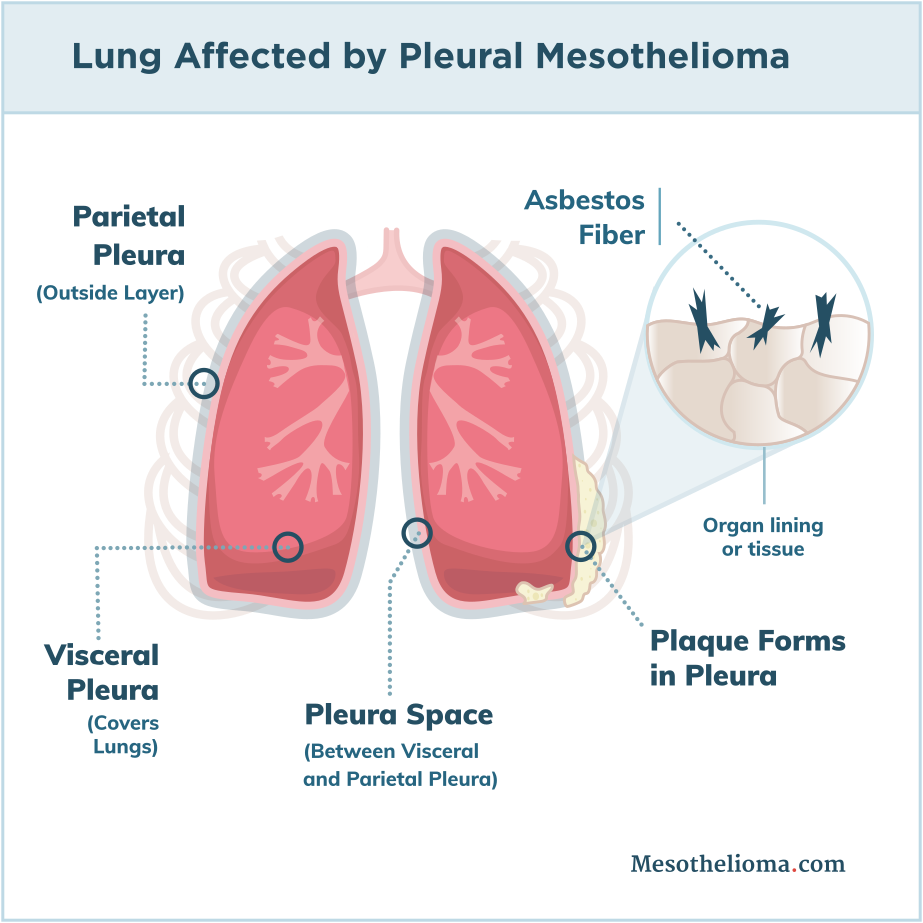
Malignant pleural mesothelioma is a rare cancer of the lining around the lungs, called the pleura. It is caused by asbestos fibers. After inhalation, the fibers can embed in the pleura, causing inflammation and scarring. Over time, these processes can lead to the development of mesothelioma tumors.
Pleural Mesothelioma Facts
- Pleural malignant mesothelioma is the most common form of mesothelioma cancer.
- Symptoms of pleural mesothelioma include chest pain, dry cough, fatigue and shortness of breath.
- Some pleural mesothelioma patients have achieved long-term survival after aggressive treatment, but it is not considered to be a curable cancer.
- A patient’s prognosis will vary depending on their individual case, with an average life expectancy of about 18 months.
- Each year, about 2,500 people are diagnosed with pleural mesothelioma.
- Diagnosis typically consists of multiple tests, including scans and biopsies.
- Pleural mesothelioma is often treated with chemotherapy, surgery, radiation therapy and immunotherapy.



What Is the Prognosis for Pleural Mesothelioma?
As with all types of malignant mesothelioma, prognosis for pleural malignant mesothelioma depends on a number of factors. For patients who do not receive treatment, the median survival time is six months. However, certain types of treatment can improve life expectancy, such as surgery combined with chemotherapy.
| 1 year after diagnosis | 73% |
| 3 years after diagnosis | 23% |
| 5 years after diagnosis | 12% |
| 10 years after diagnosis | 4.7% |
The most important mesothelioma prognosis factors of pleural malignant mesothelioma patients are:
- Cell type (histopathology)
- Stage of mesothelioma
- Patient’s gender and age
Most pleural mesothelioma patients are diagnosed with the epithelioid cell type, which is the most common. Epithelioid cells typically form in solid sheets or cord arrangements, meaning they adhere closely together and don’t metastasize as quickly. They are also the most responsive to treatment. Typically, pleural mesothelioma patients with the epithelioid cell type survive 19 months.
The other cell types, sarcomatoid and biphasic, are less common and indicate a worse prognosis than epithelioid. Sarcomatoid mesothelioma doesn’t respond well to treatment and often metastasizes, leaving patients a prognosis of about eight months.
Patients with biphasic pleural mesothelioma experience an intermediate life expectancy, depending on whether epithelioid or sarcomatoid cells are more dominant.
According to recent data, within the last decade, malignant pleural mesothelioma patients have been surviving longer overall as available treatments and diagnostic methods improve. Some patients are now becoming long-term survivors. Heather Von St. James was diagnosed with pleural mesothelioma in 2005 with an initial prognosis of 15 months. Following her treatment, she is now a survivor of more than a decade and a half.
 Did You Know?
Pleural mesothelioma is the most common type of mesothelioma and is most often diagnosed in men over age 60.
80 – 90% of all mesothelioma cases are pleural mesothelioma and occur in men 65 or older.
Did You Know?
Pleural mesothelioma is the most common type of mesothelioma and is most often diagnosed in men over age 60.
80 – 90% of all mesothelioma cases are pleural mesothelioma and occur in men 65 or older.
What Causes Pleural Mesothelioma?
Malignant pleural mesothelioma is caused by inhalation of asbestos fibers. The mineral slivers can travel through lung tissue and lodge in the pleura. Over time, asbestos fibers cause inflammation. The fibers can also activate biological pathways that lead to DNA damage. As a result, mesothelioma tumors may develop.
Other factors may contribute to the development of mesothelioma, including:
- Erionite exposure: Erionite is a natural mineral similar to asbestos. It has been linked to mesothelioma and lung cancer.
- Radiation exposure: Radiation treatments for cancer can damage healthy cells, potentially leading to cancer. Prior radiation therapy has been tentatively linked to mesothelioma.
What Are the Symptoms of Pleural Mesothelioma?
After asbestos exposure, it can take 10 to 50 years for pleural mesothelioma symptoms to present. Symptoms typically first present in the chest cavity and respiratory system.
Pleural Mesothelioma Symptoms
- Chest pain
- Coughing up blood
- Difficulty swallowing
- Dry cough
- Fatigue
- Fever
- Fluid in the lung (pleural effusion)
- Night sweats
- Shortness of breath (dyspnea)
- Weight loss
As the disease becomes more advanced, new and worsening symptoms may arise. For instance, stage 4 pleural mesothelioma symptoms may include coughing up blood and difficulty swallowing.
Pleural malignant mesothelioma patients may be diagnosed with a co-occurring asbestos-related condition, which can impact symptom onset.
These asbestos-related conditions may also develop independently of pleural mesothelioma:
- Pleural effusion occurs when an abnormal amount of fluid collects in between the two layers of the pleura. This fluid can compress the lungs, making it difficult to breathe. Pleural effusion and associated breathing problems are common symptoms in pleural mesothelioma.
- Pleural plaques are areas of thickened tissue on the surface of the pleura. Pleural plaques often do not cause symptoms. This condition is one of the most common side effects of asbestos exposure. Asbestos-exposed individuals with pleural plaques may have an elevated risk of developing mesothelioma.
- Pleural thickening is a condition in which scar tissue thickens the pleura. Pleural thickening can be benign or malignant. It is caused by asbestos exposure and other conditions that cause inflammation. According to one study, the majority of pleural mesothelioma patients experience pleural thickening.
- Asbestosis is a benign, chronic lung disease caused by inhaling asbestos fibers. It is a form of pulmonary fibrosis. Patients with asbestosis develop scar tissue within their lungs. This makes the lungs less flexible and breathing more difficult. Patients with asbestosis may have an increased risk of developing pleural mesothelioma.

How Is Pleural Mesothelioma Diagnosed?
Diagnosing pleural mesothelioma often consists of multiple tests. One or more imaging scans, such as an X-ray or CT scan, may be performed first to identify tumors or metastasis (spreading of disease). If a tumor is detected, blood tests may be performed to look for certain biomarkers (high levels of specific substances in the blood), which can help differentiate mesothelioma from other conditions.
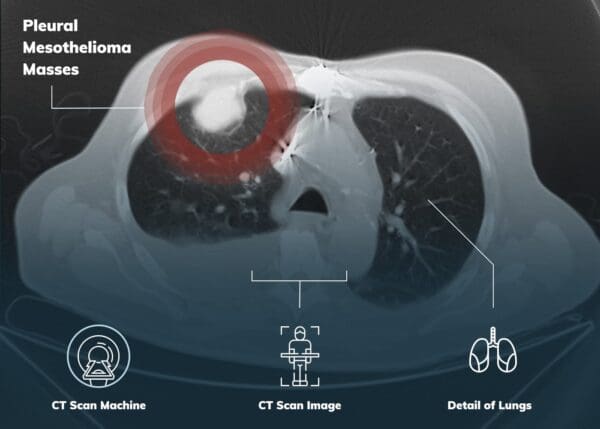
Currently, a biopsy is the only way to verify a malignant pleural mesothelioma diagnosis. Tests like a thoracentesis or thoracoscopy may be performed to take a tissue or fluid sample for analysis. For a thoracentesis, a doctor will insert a fine needle to remove fluid buildup in the chest.
A thoracoscopy is more invasive. Doctors insert a viewing tube called a thoracoscope into the chest to inspect the lungs and surrounding pleura. They can then remove a tissue sample or draw fluid for analysis. After the biopsy, a pathologist will study the cells to make a definitive diagnosis, including cell type and how the disease is expected to progress.
Malignant Pleural Mesothelioma Stages
As part of the diagnostic process, a mesothelioma specialist will also determine the stage of the disease, or how far it has spread. A patient’s stage is an important indicator of prognosis, and also helps determine available treatment options.
The most common system used to determine pleural mesothelioma stage is the Tumor, Node, Metastasis or TNM staging system. Doctors will use the system to score a specific area of the body based on the size of the tumor, if the cancer has spread to the lymph nodes and if the cancer has spread to distant organs.
| Stage 1 | 21 months |
| Stage 2 | 19 months |
| Stage 3 | 16 months |
| Stage 4 | 12 months |
Stage 1 and stage 2 pleural mesothelioma indicate little to no metastasis, while advanced stages may have distant spreading to lymph nodes and other organs.
After the stage is determined, the medical team can develop an effective treatment plan for an individual’s case.
Pleural Mesothelioma Doctors
Finding a pleural mesothelioma doctor is an essential aspect of a patient’s care. Since the cancer is rare, many primary care physicians and oncologists have little to no experience with the disease. A specialist can accurately make a malignant mesothelioma diagnosis and develop personalized treatment plans, often using new research and clinical trials.
Top Pleural Mesothelioma Doctors in the Country




Pleural Mesothelioma Treatment Options
Pleural mesothelioma is typically treated with a multimodal approach, combining standard treatments like surgery, chemotherapy medications and radiation. A pleural mesothelioma treatment plan will largely depend on the cell type and stage of disease. Generally, treatment plans are not intended to cure the disease.
Mesothelioma surgery is common for pleural mesothelioma patients. The surgery may be aggressive with the goal of extending life expectancy, or less aggressive with the goal of palliating symptoms (relieving discomfort).
Surgery may be an option for early-stage malignant pleural mesothelioma patients. Pleurectomy/decortication (P/D) is one common surgical option that involves removal of the lining of the lung and chest wall, as well as other impacted tissues and organs.
Another option is an extrapleural pneumonectomy (EPP). The more aggressive procedure includes removing the affected lung, part of the diaphragm and the linings of the heart and lungs. Recent clinical trials have found these surgeries can extend life expectancy to around three years, especially when applied multimodally with chemotherapy and/or radiation.

After receiving a prognosis of 15 months, pleural mesothelioma patient Heather Von St. James underwent an extrapleural pneumonectomy on February 2, 2006. Heather’s surgery, chemotherapy and radiation were successful. She’s survived more than a decade and now works as a mesothelioma awareness advocate.
Doctors often recommend chemotherapy as an additional treatment before or after surgery, or as a first-line therapy for patients with more advanced disease. A combination therapy of pemetrexed (Alimta®) and cisplatin is most commonly prescribed, though researchers continue to test new combinations. Radiation therapy may also be recommended for select patients to shrink tumors, which may also help relieve symptoms.
When determining treatment for pleural mesothelioma, patients should consider the cost. Reports show one course of treatment with Alimta® can cost upwards of $50,000, while surgeries like a pneumonectomy can cost at least $17,000.
Understanding treatment costs, along with the risks and benefits of available therapies, is crucial as patients and their loved ones make treatment decisions.
Emerging and Experimental Treatments
Because malignant pleural mesothelioma comprises the majority of mesothelioma cases, most experimental treatment options focus on this specific type. Promising treatments like immunotherapy, gene therapy and photodynamic therapy have shown early success in extending life expectancy in various clinical trials.
Research is also advancing the efficacy of standard treatments. One study tested pleurectomy/decortication or extrapleural pneumonectomy followed by a heated chemotherapy wash.
Results showed:
- A median survival of 35.3 months
- A median progression-free survival of 27.1 months
This approach improved overall survival and progression-free survival versus earlier studies.
Researchers continue to investigate mesothelioma treatment options to decrease recurrence rates and limit disease progression for patients.
Have a Question About Pleural Mesothelioma? Ask experienced mesothelioma advocate Jennifer Lucarelli Ask a Question
Common Questions About Pleural Mesothelioma
What causes pleural mesothelioma?
What are the symptoms of pleural mesothelioma?
How is pleural mesothelioma diagnosed?
Is pleural mesothelioma curable?
How long do pleural mesothelioma patients live?
Note: This page contains statistics gleaned from large groups of patients. These statistics cannot forecast a single patient’s risk, cancer experience or the success of any given treatment. Patients should discuss all cancer screening and treatment decisions with an experienced oncologist.
Sources
American Cancer Society. What Causes Malignant Mesothelioma? Updated November 2018.
Burt B, Richards WG, et al. A Phase I Trial of Surgical Resection and Intraoperative Hyperthermic Cisplatin and Gemcitabine for Pleural Mesothelioma. Journal of Thoracic Oncology. September 2018;13(9):1400-1409. doi: 10.1016/j.jtho.2018.04.032
Enewold L, Sharon E, et al. Patterns of care and survival among patients with malignant mesothelioma in the United States. Lung Cancer. October 2017;112:102-108. doi: 10.1016/j.lungcan.2017.08.009
Friedberg JS, Simone CB II, et al. Extended Pleurectomy-Decortication–Based Treatment for Advanced Stage Epithelial Mesothelioma Yielding a Median Survival of Nearly Three Years. The Annals of Thoracic Surgery. March 2017;103(3):912–919.
Ismail-Khan R, Robinson L, et al. Malignant Pleural Mesothelioma: A Comprehensive Review. Cancer Control. October 2016;(4):255-263.
Jhavar S, Pruszynski J, et al. Intensity modulated radiation therapy after extra-pleural pneumonectomy for malignant pleural mesothelioma is feasible without fatal pulmonary toxicity and provides good survival. Asia Pacific Journal of Clinical Oncology. March 2017. doi: 10.1111/ajco.12680
Miles SE, Robinson L, et al. Clinical consequences of asbestos-related diffuse pleural thickening: A review. Journal of Occupational Medicine and Toxicology. 2008;3:20. doi: 10.1186/1745-6673-3-20
Pairon JC, Laurent F, et al. Pleural Plaques and the Risk of Pleural Mesothelioma. Journal of the National Cancer Institute. February 2013;105(4P):293-301. doi: 10.1093/jnci/djs513
Rossini M, Rizzo P, et al. New Perspectives on Diagnosis and Therapy of Malignant Pleural Mesothelioma. Frontiers in Oncology. April 2018;8:91. doi: 10.3389/fonc.2018.00091
Shavelle R, Vavra-Musser K, et al. Life Expectancy in Pleural and Peritoneal Mesothelioma. Lung Cancer International. January 2017: 2782590. doi: 10.1155/2017/2782590
Sugarbaker DJ, Richards WG, et al. Extrapleural pneumonectomy in the treatment of epithelioid malignant pleural mesothelioma: novel prognostic implications of combined N1 and N2 nodal involvement based on experience in 529 patients. Annals of Surgery. October 2014;260(4):577-582. doi: 10.1097/SLA.0000000000000903
Free Pleural Mesothelioma Guide


 Medically
Reviewed by
James Stevenson, MD
Thoracic Medical Oncologist
Medically
Reviewed by
James Stevenson, MD
Thoracic Medical Oncologist
Dr. James Stevenson is a Board-Certified Medical Oncologist. He specializes in treating mesothelioma and lung cancer and practices at the Cleveland Clinic in Cleveland, Ohio.