Asbestos on Amphibious Warships

Amphibious warships were large vessels built to transport troops and equipment. The military used these ships frequently throughout the wars of the 20th century. Like other naval vessels, amphibious warships were often constructed and repaired with asbestos parts. As a result, many veterans and shipyard workers were exposed to the mineral.
Learn About Asbestos Exposure on Navy Ships in Our Free Guide
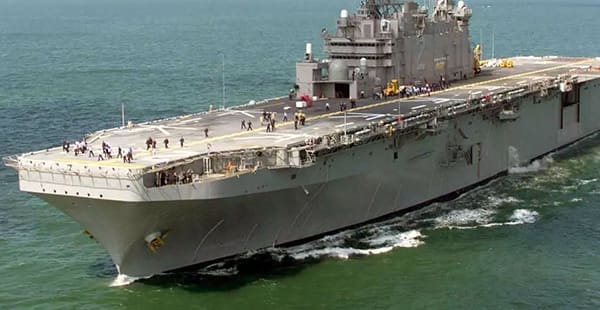
History of Amphibious Warships
Amphibious warships are used to launch land attacks from sea. There are two main classifications of amphibious assault vessels:
- Troop transports
- Cargo transports
The United States Navy and Marine Corps used amphibious warships frequently in World War II (WWII) and other wars throughout the 20th century. Amphibious warships should not be confused with landing ships, which dock directly ashore.
A total of 388 amphibious attack transport ships served in WWII. The Navy divided these ships into several different classes. The ships typically carried the APA (troop transports) or AKA (cargo transport) hull designations.
Many of these ships were originally constructed as merchant ships or freighters and were retrofitted as amphibious warships. At the time of their construction, the Navy required asbestos use in its ships.
One of the most notable uses of amphibious warships was during the D-Day invasion of Normandy. These ships helped transport troops and landing equipment to the battle zone. They were also used across the Pacific for island-hopping campaigns. Some of these ships later served in Korea and Vietnam.
The Navy recognized the need for differentiation of its fleet in the late 1960s. It reclassified 41 of these vessels as amphibious transports (LPA) and 13 as small amphibious transports (LPR).
Further differentiation emerged as the military designed new classes. However, the asbestos-containing amphibious warships began to fall out of favor around the late 1960s. By 1969, only a few of the original amphibious warships remained in service.
The last of these ships were decommissioned or sold abroad around 1980. The Navy discontinued asbestos use around the same time.
Amphibious Warships’ History at a Glance
- Other Names: Amphibious assault ships, attack transport, cargo transport, dock landing ship, gator freighter, troop transport
- Years of Operation: 1940 – 1980
- Wartime Operations: World War II (WWII), Korean War, Vietnam War
- Size of Crew: Amphibious warships carried smaller crews, often with fewer than 100 individuals. However, they transported as many as 1,500 enlisted officers at a time.
- Size of Ship: 400 – 500 feet long
- Noteworthy Ships: USS Cavalier, USS Elmore, USS Queens
Notable Amphibious Warships
The military built amphibious warships to safely transport troops and supplies. The Navy and Marine Corps frequently used these ships in Pacific conflicts throughout WWII. The USS Queens and the USS Cavalier were two notable amphibious warships. Asbestos was used on these and other amphibious warships to provide resistance to heat and explosives.
As a result, many individuals aboard amphibious warships may have been exposed to the mineral. Anyone exposed to asbestos risks developing a related illness, such as mesothelioma cancer or lung cancer.
USS Queens (APA-103)
The USS Queens was a Windsor-class amphibious attack transport. She was constructed in 1942 by Bethlehem Steel Corporation, a known user of asbestos. Asbestos companies also provided the ship’s propulsion systems, including two Babcock & Wilcox steam turbines.
In 1944, the Navy commissioned the USS Queens to serve in WWII. She was assigned to the Asiatic-Pacific Theater and served two years in this arena. In 1946, the ship was decommissioned and given to the National Defense Reserve Fleet.
Just two years later, civilian passenger company American Export Lines purchased USS Queens and renamed her SS Excambion. She provided service between New York City and the Mediterranean from 1948 to 1959. After her civilian service, the company returned the USS Queens to the National Defense Reserve Fleet.
In 1960, the Texas Maritime Academy loaned the ship and rechristened her as the USTS Texas Clipper. For three decades, she served as a training ship for sea cadets and a dormitory for Seaborne Conservation Corps members.
In 2006, the ex-USS Queens was transferred to Texas Parks & Wildlife for use as an artificial reef. To prepare for her new life, crews removed all toxic materials still aboard the vessel. This included 1,680 cubic yards of asbestos. She was sunk in 2007.
The life of the USS Queens demonstrates how many people may unwittingly come into contact with asbestos. Throughout her life, the USS Queens may have exposed veterans, crew members, civilian passengers, cadets and demolition workers.
USS Cavalier (APA-37)
The USS Cavalier was a Bayfield-class amphibious warship. The Navy classified her as an attack transport vessel under the APA hull designation in 1943. Her outfit included machinery and products manufactured by asbestos companies, including:
- General Electric (GE) gears and geared turbine
- Combustion Engineering boilers
These products may have included asbestos when installed on the USS Cavalier.
The USS Cavalier served several campaigns in the Asia-Pacific and Far East regions during her short life. She was also involved in the Korean War and Vietnam War. At several points during these campaigns, the USS Cavalier returned to the Mare Island Naval Shipyard in Vallejo, California, for repairs.
Western Asbestos Company products were used during the USS Cavalier’s repairs in 1950, 1951, 1952, 1954 and 1957. As a result, the USS Cavalier is one of hundreds of ships on the company’s trust fund list as a potential asbestos exposure site.
The USS Cavalier was ultimately decommissioned and struck from the Naval Register in 1968. During her life, she earned five battle stars for WWII service, four battle stars for Korean War service, five campaign stars for Vietnam War service, the Armed Forces Expeditionary Medal and the Vietnam Service Medal.
 Did You Know?
Asbestos exposure is still responsible for thousands of deaths each year.
Victims of asbestos exposure who have been diagnosed with mesothelioma may be eligible for financial compensation.
Did You Know?
Asbestos exposure is still responsible for thousands of deaths each year.
Victims of asbestos exposure who have been diagnosed with mesothelioma may be eligible for financial compensation.
Complete List of Amphibious Warships
Hundreds of Navy and Marine Corps ships built in the 20th century contained asbestos. As a result, construction, battle, repair and maintenance may have disturbed asbestos fibers aboard these ships. Veterans and other service members may have been exposed to the mineral during these activities.
Below is a list of amphibious warships where service members may have experienced asbestos exposure.
Asbestos Use on Amphibious Warships
For many years, the Navy required all contracted shipyards to build their vessels with asbestos components. The mineral was considered standard use at the time because of its durability, chemical resistance and heat resistance. In particular, asbestos’ resistance to high temperatures and flammability made it a popular choice for warships.
Many ship materials contained asbestos. Common asbestos-containing products aboard U.S. Navy ships include boilers, engines, pipe insulation, pumps and turbines.
Hull designations and classes of amphibious vessels with known use of asbestos include:
- AGC (classes include Adirondack, Appalachian, Barnegat, Mount McKinley)
- AKA (classes include Andromeda, Arcturus, Artemis, Charleston, Tolland)
- APA (classes include Arthur Middleton, Bayfield, Crescent City, Doyen, Frederick Funston, Gilliam, Harris, Harry Lee, Haskell, Heywood, John Penn, McCrawley, Ormsby, Paul Revere, President Jackson, Sumter, Windsor)
- APB (classes include Benewah, LST-542)
- APD (classes include Buckley, Caldwell, Charles Lawrence, Clemson, Crosley, Rudderow, Wickes)
- CVE (classes include Commencement Bay)
- LCC (classes include Blue Ridge)
- LFR (classes include LSM(R)-501)
- LHA (classes include Tarawa)
- LKA (classes include Charleston)
- LPA (classes include Haskell)
- LPD (classes include Austin, Raleigh)
- LPH (classes include Casablanca, Essex, Iwo Jima)
- LPR (classes include Buckley, Crosley)
- LSD (classes include Anchorage, Ashland, Casa Grande, Thomaston)
- LSV (classes include Osage)
These Navy vessels included large amounts of asbestos. For example, some APA-designated vessels included up to 1,680 cubic yards of asbestos. Exposure to the mineral put veterans, shipyard workers and crew members at high risk of developing an asbestos-related illness.
Who Was at Risk of Asbestos Exposure on Amphibious Warships?
Any individual who came into contact with an amphibious warship may have been exposed to asbestos. Occupational exposure may have been minimal for those with infrequent contact with asbestos materials. However, there is no safe level of asbestos exposure.
Individuals who may have experienced asbestos exposure aboard amphibious warships include:
- Boatbuilders
- Boilermakers and repairmen
- Electricians
- Insulators
- Kitchen staff
- Machinists
- Machinist’s mates
- Mechanics
- Medical officers
- Merchant Marines
- Naval officers
- Pipefitters
- Plumbers
- Sheet metal workers
- Shipwrights
- Shipyard workers
- Steamfitters
- Veterans
- Welders
- Woodworkers
Navy veterans, Marine Corps veterans, shipbuilders and other professionals may have experienced occupational asbestos exposure aboard amphibious warships. Common areas of exposure included boiler rooms, engine rooms and other areas with high-temperature equipment.
Exposure can lead to serious asbestos-related diseases, including mesothelioma and asbestosis.
Compensation for People Exposed on Amphibious Warships
Veterans and other individuals who worked around amphibious warships may have been exposed to asbestos. These workers may be eligible for compensation for resulting asbestos diseases.
There are several avenues for compensation, including:
- Filing a mesothelioma lawsuit (which may result in a verdict or settlement)
- Filing a asbestos trust fund claim
- Filing a VA claim
Asbestos trust fund claims are available to individuals who were exposed to asbestos materials manufactured, installed, serviced or repaired by an asbestos company with a trust fund. These trust funds were often set up during bankruptcy proceedings to protect money for future asbestos claims.
The Western Asbestos Settlement Trust handles asbestos claims related to the MacArthur Company, Western Asbestos Company and Western MacArthur Company. Some of these companies manufactured asbestos products used in shipbuilding.
Trust documents list hundreds of ships built or repaired using these companies’ asbestos products. Several amphibious warships are listed on this document. As a result, veterans and shipbuilders who worked on amphibious warships may have been exposed to asbestos while working with MacArthur Company, Western Asbestos Company and Western MacArthur Company products.
The trust was initially funded with $2 billion. Individuals who believe they may have been exposed to asbestos in products manufactured by any of the participating companies should contact a law firm. An experienced mesothelioma attorney can help confirm eligibility and handle the claim filing process.
Filing for compensation can help veterans and other asbestos victims get the compensation they deserve. It can also help victims and their families pay for medical expenses, cover lost wages and punish responsible parties. Mesothelioma patients and their loved ones should contact a mesothelioma lawyer to determine their compensation options.
Sources
Naval History and Heritage Command. Cavalier.
Texas Parks & Wildlife. Spotlight on the Clipper.
USS Elmore (APA-42). What is an APA?
Western Asbestos Settlement Trust. 2009 Archive.
Western Asbestos Settlement Trust. Western Ships Built List (09/2013) (PDF).
Western Asbestos Settlement Trust. Western Ships Repaired List (04/2015) (PDF).
Legal Rights for Mesothelioma Victims

Tara Strand specializes in writing content about mesothelioma and asbestos. She focuses on topics like mesothelioma awareness, research, treatment, asbestos trust funds and other advocacy efforts.

 Legally
Reviewed by
Jennifer Lucarelli
Mesothelioma Lawyer and Legal Advisor
Legally
Reviewed by
Jennifer Lucarelli
Mesothelioma Lawyer and Legal Advisor
For more than two decades, Jennifer Lucarelli has served as Legal Advisor at Mesothelioma.com. She has advocated for more than 1,000 asbestos victims, securing millions in settlements and helping them access quality medical care.