Secondary Asbestos Exposure

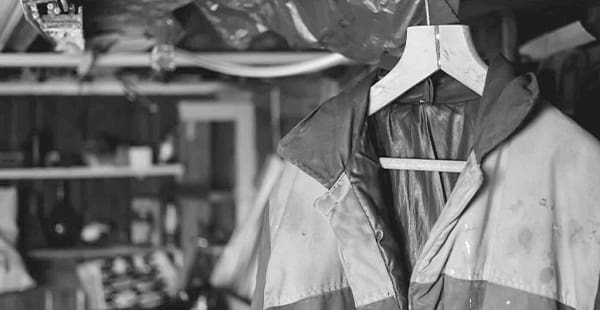
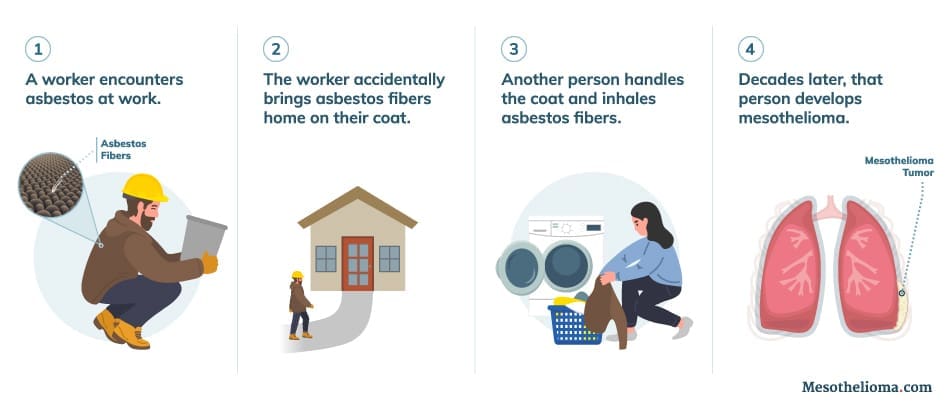
Secondary asbestos exposure occurs when a person who works with or around asbestos brings the mineral home. Fibers may lodge in clothing or the person’s hair. Loved ones may then experience secondary exposure by inhaling the transferred fibers. This may cause mesothelioma or other asbestos diseases.
Learn About Secondhand Asbestos Exposure
What Is Secondary Asbestos Exposure?
Secondary exposure is one of several ways in which people may encounter asbestos. It follows primary or direct asbestos exposure and is a form of non-occupational exposure. Secondary exposure is also the main cause of mesothelioma in women.
Secondary asbestos exposure can take different pathways. Because of this, it can easily affect people who had no direct contact with asbestos fibers. It may begin with a person who encounters the mineral at work or in the natural environment:
- Occupational asbestos exposure: Stray fibers may stick to the clothes or gear worn by people who work with or near asbestos. If the fibers are not removed, workers can carry them home and put loved ones at risk of exposure.
- Environmental asbestos exposure: Naturally occurring asbestos can stick to clothing or hair during outdoor activities. People may not even realize they picked up the fibers. If a person carries the asbestos elsewhere, family members or others could experience secondary exposure.
Secondary exposure commonly occurs at lower concentrations than primary exposure. It may also start at an earlier age, as children can be exposed by an asbestos worker parent. No amount of asbestos exposure is safe, and secondary exposure can be as dangerous as direct exposure.
Secondary exposure can cause asbestos-related diseases including mesothelioma, lung cancer and asbestosis.
- Domestic asbestos exposure
- Household asbestos exposure
- Indirect asbestos exposure
- Para-occupational asbestos exposure
- Secondhand asbestos exposure
- Take-home asbestos exposure
How Does Secondary Exposure Differ From Environmental Asbestos Exposure?
Secondary exposure may be confused with environmental asbestos exposure. However, environmental exposure involves direct exposure to asbestos in the natural world. Secondary exposure occurs when someone experiences primary exposure and brings asbestos dust to a second location. Individuals in that second location may then experience secondary exposure.
 Did You Know?
There are only 3,000 mesothelioma cases per year in the U.S. Many doctors have little or no experience with this rare cancer.
It is imperative to consult with an experienced mesothelioma specialist to ensure you or your loved one receives the best treatment plan possible.
Did You Know?
There are only 3,000 mesothelioma cases per year in the U.S. Many doctors have little or no experience with this rare cancer.
It is imperative to consult with an experienced mesothelioma specialist to ensure you or your loved one receives the best treatment plan possible.
Who Is at Risk of Secondary Asbestos Exposure?
Asbestos workers are people with jobs that expose them to asbestos or asbestos-containing materials. Persons who live with asbestos workers are at risk of secondary exposure.
Use of asbestos peaked prior to the 1970s and then declined as regulatory authorities enacted laws restricting its use.
Even at the height of asbestos usage, men were at the greatest risk of exposure. During this period, men were more likely to hold jobs with a high risk of direct asbestos exposure. At the same time, the family and household members of these men were at risk of secondary asbestos exposure.
Workers in some industries, like construction, still have a risk of asbestos exposure today. As a result, their loved ones are at risk of secondary exposure.
Family members of asbestos workers face a risk of secondary exposure. Household members of individuals in the following occupations may have experienced secondhand asbestos exposure:
- Asbestos abatement or removal workers
- Auto mechanics
- Construction workers
- Insulators
- Maintenance or repair staff in asbestos-containing structures
Note: The list above includes current and historical occupations with substantial asbestos exposure risks. It is not an exhaustive list.
Data from published medical studies aligns with this information. One publication reviewed more than 30 case reports of domestic asbestos exposure. Wives and family members of asbestos workers were the most common subjects of these reports. The researchers found these asbestos worker family members had an elevated risk of pleural mesothelioma versus the average person.
Secondhand Asbestos Exposure Risks Persist Despite Declining Asbestos Usage
Usage of asbestos products has declined since the 1970s. That same decline has not yet appeared in asbestos-related conditions. Experts attribute this lag to the latency period of asbestos diseases. For example, mesothelioma has a latency period ranging from around 10 to 50 years. This means it can take between 10 and 50 years for symptoms to appear after initial asbestos exposure.
Thus, people who experienced secondary exposure in the 1970s may only recently have begun showing signs of mesothelioma. Family members of asbestos workers should report their exposure and any mesothelioma symptoms to a physician as soon as they arise.
The United States has not yet fully banned asbestos. As a result, workers in certain industries and their loved ones continue to risk exposure.
One of the most studied examples of asbestos exposure comes from Libby, Montana. W.R. Grace Company had a vermiculite mine just outside of town. It provided ample opportunities for Libby residents to encounter asbestos fibers:
- Libby residents with no connections to the mine may have experienced environmental exposure.
- Mine workers experienced direct, occupational exposure.
- Miners’ family members had secondary, household exposure.
Researchers have documented pleural and peritoneal mesothelioma among Libby residents.
One Libby-based study underscored the risks of secondary asbestos exposure. It analyzed the asbestos-related deaths of 694 residents. Less than 15% of those deaths were tied to employment with W.R. Grace. This links the bulk of asbestos-related Libby deaths to secondary or environmental exposure.
Source: Journal of Exposure Science and Environmental Epidemiology
Dad Brought Home Asbestos on His Clothes: My Secondhand Exposure Story
My name is Heather Von St. James. As a mesothelioma survivor, I know the risks of secondhand asbestos exposure all too well. My father worked with asbestos and often brought home his work coat. As a kid, I wore this coat while I did chores. But I didn’t realize that coat was covered in asbestos fibers.
Years later, I received a pleural mesothelioma diagnosis. At just 36 years old, I was given just 15 months to live. After seeking the opinion of an experienced mesothelioma doctor, I underwent aggressive treatment. Thanks to my wonderful surgeon and care team, I now have no evidence of cancer. These days, I spend a lot of time advocating for mesothelioma patients and a nationwide asbestos ban. I hope I can help keep some other father from accidentally exposing their child to asbestos.
Studies Say Secondary Asbestos Exposure Is the Most Common Cause of Mesothelioma in Women
Heather’s story of secondary asbestos exposure is not unique, especially among women. Research shows secondary exposure is the most common form of asbestos exposure in women.
One study investigated mesothelioma and asbestos exposure in 91 women. Of the women, 15% experienced only secondary exposure. Researchers found 29% of women in the study experienced both household and environmental asbestos exposure.
This means about 44% of women in the study experienced some form of secondary asbestos exposure. In comparison, only 3% of men experienced secondary exposure. According to the authors, secondary asbestos exposure is the primary cause of mesothelioma in women.
In another study, researchers evaluated more than 1,000 mesothelioma cases in Italy. Secondary asbestos exposure caused 35 of these cases, 33 of which occurred in women. All 35 cases involved household exposure resulting from an asbestos worker family member. Many of these asbestos workers were employed in shipyards.
The authors concluded secondary exposure increased the risk of pleural mesothelioma in women.



Common Sources of Secondary Asbestos Exposure
Asbestos-containing materials may be friable — or easily crumbled — and can release dangerous fibers into the air. Asbestos fibers are also tiny and needle-like. These properties let asbestos cling to fabric, hair and other materials.
Many workers may not realize they have been exposed to asbestos. This can lead them to skip decontamination, as it seems unnecessary at the time. In this way, some workers may unwittingly bring home asbestos fibers. Anything a person encounters while still carrying asbestos fibers can become a source of secondary exposure.

Secondhand Exposure from Automobiles
If an asbestos worker carries asbestos dust into their vehicle, the fibers may get stuck in the car. Any fabrics, carpet or other woven material could retain asbestos fibers. This can turn the vehicle into a secondary exposure source for future passengers.
Secondhand Exposure from Personal Contact
If an asbestos worker carries fibers home, the worker may serve as a source of secondary exposure. Ordinary interactions, such as hugs and pats on the back, may release asbestos into the air. Once airborne, other family members may inhale or ingest the fibers. Thus, normal interaction with spouses, sons and daughters could lead to asbestos exposure.
Asbestos Exposure at Home: Risks for Direct and Secondary Exposure
Another study evaluated dust samples from asbestos factory workers’ homes. The study revealed asbestos fibers still present 20 – 25 years after the factory ceased operations. This means the threat of secondary asbestos exposure may persist much longer than one might expect. It also highlights the value in having homes tested for asbestos.
Even in homes that were never occupied by asbestos workers, asbestos may still be present. Older homes built before 1980 may contain asbestos products such as floor tiles or adhesives.
Home occupants should have their homes tested for asbestos by a professional. Suspected asbestos materials should not be disturbed. If asbestos is present, only professionals should attempt to remove or dispose of it.
Asbestos-Covered Furniture
Couches, chairs, beds and other furniture contain materials capable of retaining asbestos fibers. If an asbestos-carrying person or their contaminated clothes encounter furniture, asbestos dust may be left behind. This could transform the furniture into a source of secondary asbestos exposure.
Laundering Asbestos-Covered Clothing
It may seem illogical at first, but washing asbestos-contaminated clothes can cause domestic exposure. Conventional washing machines are not capable of removing asbestos dust. Instead, they may spread the fibers to other items in the wash.
Washing asbestos-contaminated work clothes also presents a risk to the person doing the laundry. The fibers may become airborne through the course of washing. For instance, shaking off clothes before washing can release asbestos dust. Anyone working in the area might then inhale the fibers while doing the laundry.
Individuals exposed to asbestos should not try to wash their own contaminated clothing. Instead, they should follow their employer’s decontamination procedures. This may include having asbestos-contaminated clothes washed at a specialty facility.
Laundry is among the most common sources of secondary exposure reported in asbestos studies. One study looked at people who experienced different types of exposure. It measured the amount of asbestos in participants’ lung tissue. Those who washed asbestos-containing clothes had similar levels of asbestos to shipyard workers. This study highlights the dangers of handling or washing asbestos-contaminated clothes.
Health Risks of Secondary Asbestos Exposure
Asbestos is a carcinogen, meaning it can cause cancer. In fact, asbestos can cause several cancers and related illnesses. Secondary exposure commonly occurs at lower concentrations than occupational exposure. However, there is no safe level of asbestos exposure. As such, secondary exposure increases the risk of the following asbestos-related conditions:
- Malignant mesothelioma is a cancer that develops in the lining of certain tissues. The most common forms are pleural and peritoneal mesothelioma.
- Lung cancer occurs when cells within the lung become cancerous. Asbestos exposure can cause lung cancer. Asbestos-related lung cancer causes the same symptoms as any other lung cancer.
- Asbestosis is a non-cancerous lung disease caused by inhaling asbestos fibers. It is also called diffuse pulmonary fibrosis. This condition is characterized by widespread thickening and scarring of lung tissue. Fibrotic scarring can make breathing difficult.
- Pleural plaques are a benign condition caused by asbestos. Pleural plaques are areas of thickened tissue on the surface of the pleura (the lining around the lung). These plaques may calcify and harden, but they usually do not cause symptoms.
Doctors and scientists have been studying the risks of secondary exposure for decades. For instance, a 1978 publication looked into mesothelioma deaths from secondary exposure in New York. The mesothelioma patients were all women whose husbands or fathers worked in an asbestos industry. The study found these women had 10 times the risk of mesothelioma versus women who did not encounter secondary exposure.
Financial Assistance Is Available for Mesothelioma Patients Learn more with our free information packet Get Help Now
Lawsuits and Compensation for Secondary Asbestos Exposure
Asbestos victims who develop a related illness may be eligible for financial compensation. This includes patients who developed an asbestos-related disease following secondary exposure.
One option for compensation is filing a lawsuit. Asbestos liability cases may focus on a company or employer’s failure to warn of asbestos or other legal infractions. In order to succeed, these cases must usually trace the asbestos exposure to a definite source. This task may prove difficult for victims of secondary asbestos exposure.
However, hiring an experienced mesothelioma lawyer can help people trace their exposure. Top law firms specializing in asbestos and mesothelioma have experience investigating the source of exposure. They can also help navigate state laws pertaining to these types of cases.
An experienced legal team can help secondary-exposure victims determine eligibility for lawsuits and other legal options. Asbestos lawyers also determine the best jurisdiction or state to file a lawsuit. They can handle the entire filing process on the individual’s behalf.
Secondary Asbestos Exposure Victim Receives $27.5 Million
An Ohio English professor grew up in an asbestos worker household. His father worked for a brake manufacturer, where others handled asbestos products. This occupation brought asbestos dust into the family home.
The father died of lung cancer in 1994, and his son was diagnosed with mesothelioma in 2012. The professor underwent multimodal treatment. This included extrapleural pneumonectomy, a surgery that removes the cancerous lung. He also completed several rounds of chemotherapy and at least one round of radiation.
He and his wife filed an asbestos lung cancer lawsuit against the responsible asbestos product manufacturer, National Friction Products. In 2013, an Ohio court awarded the professor and his wife $27.5 million in legal damages. The award included $12.5 million in damages for him and $15 million for his wife.
Common Questions About Secondary Asbestos Exposure
Can I sue for secondary asbestos exposure?
Can asbestos be passed on?
Does secondary asbestos exposure always cause cancer?
Is there a safe level of asbestos exposure?
Sources
American Cancer Society. Lung Cancer Survival Rates.
Bianchi C, Brollo A, Ramani L, Zuch C. Asbestos-related mesothelioma in Monfalcone, Italy. Am J Ind Med. 1993 Aug;24(2):149–60.
D’ Agostin F, Michieli P, Negro C. Mesothelioma from household asbestos exposure. J Lung Health Dis. 2018 Feb 1;2(1):27–30.
D’ Agostin F, de Michieli P, Negro C. Pleural mesothelioma in household members of asbestos-exposed workers in Friuli Venezia Giulia, Italy. Int J Occup Med Environ Health. 2017 May 8;30(3):419–31.
EHS Today. English Professor, Wife Win Record-Setting Asbestos Lawsuit.
Faig J, Howard S, Levine EA, Casselman G, Hesdorffer M, Ohar JA. Changing pattern in malignant mesothelioma survival. Transl Oncol. 2015 Feb;8(1):35–9.
Gilham C, Rake C, Burdett G, Nicholson AG, Davison L, Franchini A, et al. Pleural mesothelioma and lung cancer risks in relation to occupational history and asbestos lung burden. Occup Environ Med. 2016 May;73(5):290–9.
Goldberg M, Luce D. The health impact of nonoccupational exposure to asbestos: what do we know? Eur J Cancer Prev. 2009 Nov;18(6):489–503.
Goswami E, Craven V, Dahlstrom DL, Alexander D, Mowat F. Domestic asbestos exposure: a review of epidemiologic and exposure data. Int J Environ Res Public Health. 2013 Oct 31;10(11):5629–70.
High Speed Training. Answering Your Asbestos Awareness Questions.
Miller A. Mesothelioma in household members of asbestos-exposed workers: 32 United States cases since 1990. Am J Ind Med. 2005 May;47(5):458–62.
Naik SL, Lewin M, Young R, Dearwent SM, Lee R. Mortality from asbestos-associated disease in Libby, Montana 1979-2011. J Expo Sci Environ Epidemiol. 2017 Mar;27(2):207–13.
National Cancer Institute. Asbestos Exposure and Cancer Risk.
National Technical Reports Library. Cancer Risk of Insulation Workers in the United States.
Noonan CW. Environmental asbestos exposure and risk of mesothelioma. Ann Transl Med. 2017 Jun;5(11):234.
Occupational Safety and Health Administration. 1910.1001 – Asbestos.
Occupational Safety and Health Administration. Asbestos.
Panou V, Vyberg M, Meristoudis C, Omland Ø, Weinreich UM, Hansen J, et al. Malignant mesothelioma in 91 danish women: The environmental asbestos exposure. JCO. 2017 May 20;35(15_suppl):8560–8560.
Panou V, Weinreich UM, Bak J, Vyberg M, Meristoudis C, Omland O, et al. Gender differences in asbestos exposure and disease location in 327 patients with mesothelioma. In: Pleural and Mediastinal Malignancies [Internet]. European Respiratory Society; 2017 [cited 2024 Feb 25]. p. PA4294. Available from: https://erj.ersjournals.com/lookup/doi/10.1183/1393003.congress-2017.PA4294
Peipins LA, Lewin M, Campolucci S, Lybarger JA, Miller A, Middleton D, et al. Radiographic abnormalities and exposure to asbestos-contaminated vermiculite in the community of Libby, Montana, USA. Environ Health Perspect. 2003 Nov;111(14):1753–9.
Schneider J, Straif K, Woitowitz HJ. Pleural mesothelioma and household asbestos exposure. Rev Environ Health. 1996;11(1–2):65–70.
Spirtas R, Heineman EF, Bernstein L, Beebe GW, Keehn RJ, Stark A, et al. Malignant mesothelioma: attributable risk of asbestos exposure. Occup Environ Med. 1994 Dec;51(12):804–11.
Taioli E, Wolf AS, Camacho-Rivera M, Flores RM. Women with malignant pleural mesothelioma have a threefold better survival rate than men. Ann Thorac Surg. 2014 Sep;98(3):1020–4.
Tlotleng N, Sidwell Wilson K, Naicker N, Koegelenberg CF, Rees D, Phillips JI. The significance of non-occupational asbestos exposure in women with mesothelioma. Respirol Case Rep. 2019 Jan;7(1):e00386.
Vianna NJ, Polan AK. Non-occupational exposure to asbestos and malignant mesothelioma in females. Lancet. 1978 May 20;1(8073):1061–3.
Whitehouse AC, Black CB, Heppe MS, Ruckdeschel J, Levin SM. Environmental exposure to Libby Asbestos and mesotheliomas. Am J Ind Med. 2008 Nov;51(11):877–80.
Free Mesothelioma Treatment Guide
Katy Moncivais, Ph.D., has more than 15 years of experience as a medical communicator. As the Medical Editor at Mesothelioma.com, she ensures our pages and posts present accurate, helpful information.

 Medically
Reviewed by
Francis Perry Wilson, MD
Senior Medical Advisor
Medically
Reviewed by
Francis Perry Wilson, MD
Senior Medical Advisor
Dr. Francis Perry Wilson is the Director of the Clinical and Translational Research Accelerator at the Yale University School of Medicine. He specializes in nephrology and clinical research.