
Benign Mesothelioma

Benign mesothelioma is a non-cancerous tumor with four subtypes. Each subtype grows at a different rate but does not spread to distant areas in the body. Doctors may use surgery to treat the disease. Patients with benign mesothelioma have more favorable prognoses than patients with malignant mesothelioma.
Request a Free 2026 Mesothelioma Guide Free 2026 Mesothelioma Guide
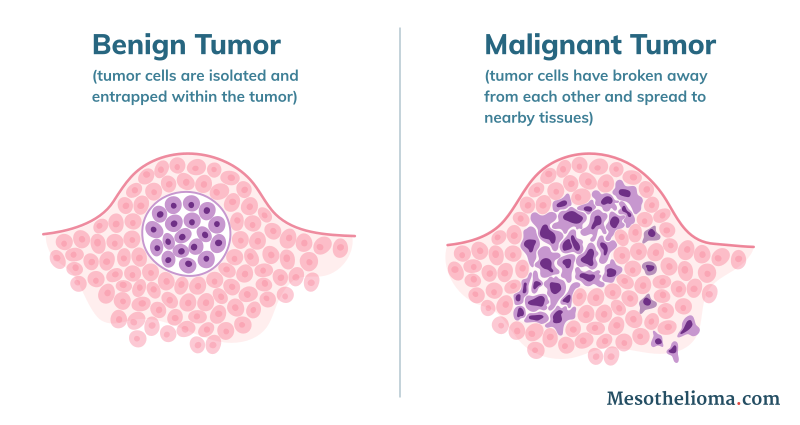
Benign Mesothelioma Cell Structure
The cell structure of benign mesothelioma tumors differs based on type. However, most subtypes are composed of epithelial cells. This cell type is the most responsive to treatment and offers a better mesothelioma prognosis. Epithelioid cells grow in clusters and are slower to metastasize than other cell types.
Benign mesothelioma may be described as non-cancerous mesothelioma.
Malignant mesothelioma can spread to other areas of the body. The cancer cells may invade organs and lymph nodes, limiting treatment options.
Benign mesothelioma tumors can grow, but they generally do not spread. This characteristic can allow for complete surgical removal.
Rare Benign Mesothelioma Types
Benign mesothelioma is rarer than the malignant form. Through the few reported cases, researchers have established four rare subtypes.
Some of the subtypes can manifest as malignant. But most have benign mesothelial cells.
Benign Multicystic Peritoneal Mesothelioma (BMPM) is a type of peritoneal mesothelioma. It occurs in the thin protective tissue that surrounds organs in the belly. It is most common in women of reproductive age. Women with a history of abdominal surgery, endometriosis or pelvic inflammatory disease may have a higher risk.
Key Facts:
- Description: Often presents as multiple fluid-filled cysts attached to the belly lining
- Symptoms: Abdominal pain, constipation, nausea, pain during intercourse and urinary obstruction
- Treatment: Surgery and may have intraperitoneal tetracycline
Well-Differentiated Papillary Mesothelial Tumor (WDPMT) is another subtype. It was formerly known as well-differentiated papillary mesothelioma (WDPM). Tumors of this subtype may form in the thin linings that surround various organs. But they mostly form in the belly lining. It may be more common in people with a history of colorectal cancer, ovarian cancer or endometriosis.
Key Facts:
- Description: Cells form finger-like shapes (papillae) and grow relatively slowly
- Symptoms: May not cause symptoms
- Treatment: Does not always need treatment but may be treated with surgery, immunotherapy or radiation
A benign adenomatoid mesothelioma tumor is a non-cancerous growth. It affects both men and women. It may start in the testicular linings, the uterus wall, fallopian tubes or other reproductive organs.
Key Facts:
- Description: A solid or cystic mass
- Symptoms: May cause abdominal or pelvic pain or may not cause symptoms
- Treatment: Surgery
Benign fibrous mesothelioma may also be called a localized fibrous tumor. They are often found in the protective lining around certain organs. But they may develop anywhere in the body.
Key Facts:
- Description: A benign tumor that grows very slowly
- Symptoms: May cause cough, breathlessness or no symptoms
- Treatment: Surgery
Diagnosing Benign Mesothelioma
Diagnosing benign mesothelioma requires several tests. These can include a medical history, physical exam, imaging scans and blood tests. Doctors cannot diagnose benign mesothelioma without collecting and testing a biopsy (a small piece of the tumor).
A biopsy is the only test that can definitively confirm mesothelioma. Doctors analyze biopsy tumor samples under a microscope. This lets doctors see the cell size, shape and arrangement and other features. Analyzing these aspects of a tumor can help doctors arrive at an accurate diagnosis.
Questions About Benign Mesothelioma? Ask experienced mesothelioma advocate Jennifer Lucarelli Ask a Question
Benign Mesothelioma Prognosis
The prognosis for benign mesothelioma is generally favorable. A diagnosis usually does not affect life expectancy. Most patients can live a full life after the tumor is removed.
Recurrence is possible with some tumors. This is especially true for benign multicystic peritoneal mesothelioma. Some tumors may also return as malignant. Patients may have a poor prognosis with malignant mesothelioma. On average, malignant mesothelioma patients live 18 – 31 months with treatment.
Survival rates may vary depending on the subtype of mesothelioma. Rates also depend on if the patient has a cancerous recurrence.
- BMPM: 5-year survival rate of 100% with surgery and heated intraperitoneal chemotherapy
- WDPMT: 5-year survival rate of 80% with multimodal treatment
The prognosis for other types of benign mesothelioma is generally good. But these types are so rare that specific statistics are difficult to find.
Doctors may recommend follow-up appointments for patients treated for benign mesothelioma. Frequent monitoring may help in maintaining a higher quality of life.
Treatment Options for Benign Mesothelioma
Treatment options for benign mesothelioma depend on the tumor type and patient characteristics. Doctors often perform surgery to remove the benign tumor. For some, the procedure is curative, removing all the tumor. But surgery does come with some risks. Patients should discuss risks with their care teams.
In some cases, doctors may use another therapy with surgery. For example, with BMPM, doctors sometimes use intraperitoneal tetracycline (antibiotic). This drug may help kill any tumor cells left behind after the surgery.
Common Questions About Benign Mesothelioma
What is the survival rate for benign mesothelioma?
How do you treat benign mesothelioma?
How common is benign mesothelioma?
Can benign mesothelioma become malignant?
Sources
Bernstein EM, Tate A, Silasi DA, Rutherford T. Benign multicystic mesothelioma: a case report of three sisters. Rare Tumors. 2009 Dec 28;1(2):e46.
Chand MT, Edens J, Lin T, Anderson I, Berri R. Benign multicystic peritoneal mesothelioma: literature review and update. Autops Case Rep. 2020 Jun 5;10(3):e2020159.
Chatterjee A, Bhatt A. Rare variants of malignant peritoneal mesothelioma: a literature review. Indian J Surg Oncol. 2023 Jun;14(Suppl 1):30–8.
Deraco M, Nizri E, Glehen O, Baratti D, Tuech JJ, Bereder JM, et al. Well differentiated papillary peritoneal mesothelioma treated by cytoreduction and hyperthermic intraperitoneal chemotherapy-the experience of the PSOGI registry. Eur J Surg Oncol. 2019 Mar;45(3):371–5.
Erdogan S, Acikalin A, Zeren H, Gonlusen G, Zorludemir S, Izol V. Well-differentiated papillary mesothelioma of the tunica vaginalis: a case study and review of the literature. Korean J Pathol. 2014 Jun;48(3):225–8.
Galateau-Sallé F, Vignaud JM, Burke L, Gibbs A, Brambilla E, Attanoos R, et al. Well-differentiated papillary mesothelioma of the pleura: a series of 24 cases. Am J Surg Pathol. 2004 Apr;28(4):534–40.
Kim KC, Vo HP. Localized malignant pleural sarcomatoid mesothelioma misdiagnosed as benign localized fibrous tumor. J Thorac Dis. 2016 Jun;8(6):E379-384.
Mehta V, Chowdhary V, Sharma R, Golia Pernicka JS. Imaging appearance of benign multicystic peritoneal mesothelioma: a case report and review of the literature. Clinical Imaging. 2017 Mar;42:133–7.
Safioleas MC, Constantinos K, Michael S, Konstantinos G, Constantinos S, Alkiviadis K. Benign multicystic peritoneal mesothelioma: a case report and review of the literature. World J Gastroenterol. 2006 Sep 21;12(35):5739–42.
Shetty, S., H, N., Prabhakar, S. P., & Rajput, A. (2017). Benign cystic peritoneal mesothelioma. International Journal of Research in Medical Sciences, 2(2), 762–764.
Weissferdt A, Kalhor N, Suster S. Malignant mesothelioma with prominent adenomatoid features: a clinicopathologic and immunohistochemical study of 10 cases. Ann Diagn Pathol. 2011 Feb;15(1):25–9.
Katy Moncivais, Ph.D., has more than 15 years of experience as a medical communicator. As the Medical Editor at Mesothelioma.com, she ensures our pages and posts present accurate, helpful information.

 Medically
Reviewed by
James Stevenson, MD
Thoracic Medical Oncologist
Medically
Reviewed by
James Stevenson, MD
Thoracic Medical Oncologist
Dr. James Stevenson is a Board-Certified Medical Oncologist. He specializes in treating mesothelioma and lung cancer and practices at the Cleveland Clinic in Cleveland, Ohio.