Smoking and Mesothelioma

Current research does not show that smoking causes mesothelioma, but asbestos exposure can cause this cancer. Smoking may affect how the body responds to asbestos, increasing a person’s risk of asbestos illnesses. For example, smoking may increase the retention of asbestos fibers in lung tissue.
Request a Free 2026 Mesothelioma Guide Free 2026 Mesothelioma Guide
Does Smoking Cause Mesothelioma?
There is no direct link between smoking and mesothelioma. But smoke inhalation may alter the body’s response to asbestos fibers. In theory, this might affect a person’s risk of developing mesothelioma, since it is caused by asbestos exposure.
How Does Smoking Affect Asbestos-Related Risks?
Smoking may affect some of the processes tied to the development of asbestos-related diseases. These processes include:
- Airway inflammation: Smoking increases inflammation in the airways. Inflammation contributes to mesothelioma development.
- Immune response to asbestos: Smoke may change the body’s natural immune response to asbestos fibers. These changes may make immune cells less capable of clearing the fibers.
- Management of debris in the lungs: Tobacco smoke decreases the lungs’ ability to remove harmful particles like asbestos. In theory, this could allow smokers to retain more asbestos fibers than non-smokers, increasing their mesothelioma risk.
Tobacco smoke may also impact people at various points in their life. For example, childhood smoke exposure may change how the body reacts to asbestos. This change might make it easier for asbestos to cause cancer. Smoking can also cause problems for people undergoing cancer treatment.
How Does Smoking Affect Mesothelioma Treatment?
Smoking may negatively impact mesothelioma treatment and recovery.
According to experts, smokers experience more chemotherapy side effects than non-smokers. Those side effects persist for a longer period of time. Pleural mesothelioma and peritoneal mesothelioma are both treated with chemotherapy.
Smoking also makes it harder for the body to recover from cancer treatments. It affects blood circulation, which can make it difficult for wounds to heal. Tobacco smoke can also increase the risk of cancer returning after treatment.
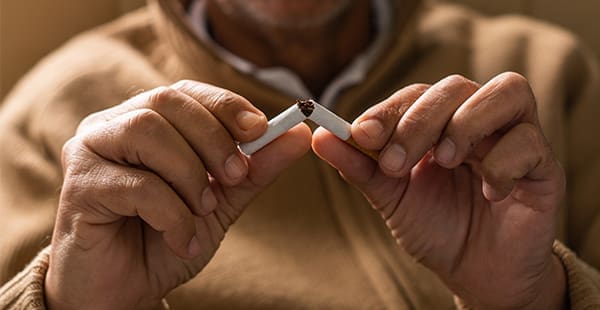
For all these reasons, doctors say patients should consider quitting smoking.
Some individuals may have experienced exposure to asbestos while smoking. For years, one cigarette brand used asbestos in its cigarette filters. Although manufacturing stopped in 1956, billions of these Kent Micronite cigarettes were sold. People who smoked these cigarettes may have inhaled multiple carcinogens at once, including asbestos.
People who smoked these asbestos cigarettes could still be at risk of developing mesothelioma. This rare cancer has a long latency period and may take decades to arise. Anyone who smoked Kent Micronite cigarettes should discuss it with a doctor. The doctor can help monitor for symptoms of mesothelioma and other asbestos diseases.



Smoking and Asbestos-Related Lung Cancer
Deaths from lung cancer make up approximately 20% of all cancer deaths in the world. While the leading cause is smoking, asbestos exposure may also cause lung cancer.
Smoking alone causes 85% – 90% of lung cancer cases. Experts estimate that asbestos causes about 4% of lung cancers in the United States.
Individuals who smoke and have been exposed to asbestos may have an elevated risk of developing various diseases, like asbestos lung cancer. Research indicates that risk may lessen if smokers quit.
- Asbestos-exposed individuals who smoke: There is an increased risk of lung cancer. Compared to never-smokers, this risk lasts for up to 20 years after they stop smoking.
- Asbestos-exposed individuals who stopped smoking less than seven years ago: The risk of lung cancer is 22 times higher than never-smokers.
A 2013 study examined the effects of asbestos and smoking on lung cancer deaths. It compared people who worked with asbestos, people who smoked and people who did both. Researchers found the following:
- Quitting smoking: Ten years after stopping smoking, former smokers had half the risk of dying of lung cancer. Thirty years after quitting, their risk was equal to that of never-smokers.
- Smoking and asbestos: People who smoked and worked with asbestos had the highest risk of dying from lung cancer.
These results highlight the dangers of asbestos and smoking. They also demonstrate the benefits of quitting smoking. Asbestos-exposed individuals who smoke may face greater risks of asbestos-related diseases than non-smokers. Still, individuals may lower their risk of developing these conditions by quitting smoking.
Smoking and Asbestosis
Asbestosis is a chronic lung disease that develops only after asbestos exposure. Once inhaled, asbestos fibers can cause inflammation and lung scarring, making breathing difficult. In some cases, symptoms do not appear until decades after exposure. The prognosis for asbestosis is generally favorable, as many patients have mild to no symptoms. Treatment options for this asbestos-related disease may include breathing treatments like asthma medications, oxygen and pulmonary rehabilitation exercises.
Smoking can also cause lung inflammation. This may help explain why smoking increases a person’s risk of asbestosis. It may also cause the lungs to retain more asbestos fibers, leading to quicker disease progression.
Questions About Asbestos-Related Lung Cancer and Smoking? Ask experienced mesothelioma advocate Jennifer Lucarelli Ask a Question
Smoking and Asbestos Exposure Risk
Asbestos is naturally fire-resistant. In the past, this quality motivated cigarette makers to add crocidolite asbestos to their filters. One brand, Kent Micronite, manufactured cigarettes with asbestos filters from 1952 to 1956. This put Kent cigarette consumers at risk of asbestos exposure. Workers at cigarette filter manufacturing plants also faced asbestos exposure risks.
Kent Micronite is the only cigarette brand known to have contained asbestos. In these cigarettes, there was no barrier between asbestos fibers and users mouths. The lack of a barrier may have increased the amount of asbestos inhalation.
One study investigated Kent filters for asbestos exposure potential. It found:
- Asbestos content: Each filter contained about 10 mg of asbestos.
- Individuals who smoked one pack per day: These consumers would inhale more than 131 million asbestos particles in one year.
- Potential ongoing impact: Several hundred thousand people may have been exposed to asbestos through these filters.
The study estimated that several hundred thousand people may have smoked these cigarettes. They may still be at risk of developing asbestos-related diseases. Asbestos law firms can help these victims hold the manufacturer accountable.
How Smoking Affects Health
Smoking can cause or contribute to many health issues. Known health impacts of smoking are:
- Difficulty with recovery from treatments, such as surgery
- Higher risk of cancer recurrence
- Increased potential for infection
- Narrowed airways
- Worsened side effects from chemotherapy
Smoking decreases the number of cilia in the lungs. Cilia are hair-like structures that move debris out of the airways. Each cigarette smoked impairs the cilia’s functionality. Long-term smoking continues to decrease the function of cilia in the lungs. Lungs with impaired cilia may be less effective at cleaning out asbestos fibers.
Smoking also elevates mucus levels and decreases oxygen intake. The mucus may increase infection risk and trap asbestos fibers. These fibers can cause scarring that also hinders oxygen intake. These effects may make any breathing difficulty worse.
The effects of smoking may complicate cancer treatment and recovery. They may also increase the chances of cancer recurrence. Doctors recommend cancer patients stop smoking, even if their disease is not smoking-related.
Common Questions About Smoking and Mesothelioma
Does smoking add to your cancer risk from asbestos exposure?
What happens if you work with asbestos and smoke?
Sources
American Cancer Society. Asbestos and Cancer Risk. Updated January 2023.
American Cancer Society. Study: Smoking Causes Almost Half of Deaths from 12 Cancer Types. June 2015.
American Thoracic Society. Asbestos exposure, asbestosis, and smoking combined greatly increase lung cancer risk. ScienceDaily. April 2013.
Berman DW and Crump KS. Update of potency factors for asbestos-related lung cancer and mesothelioma. Critical Reviews in Toxicology. October 2008;38(Supplement 1):1-47. doi: 10.1080/10408440802276167
Bledsoe JR, Christiani DC, et al. Smoking-associated fibrosis and pulmonary asbestosis. International Journal of Chronic Obstructive Pulmonary Disease. December 2014;2015(10):31-37. doi: 10.2147/COPD.S74643
Brown TA, Holian A, et al. Early life exposure to environmental tobacco smoke alters immune response to asbestos via a shift in inflammatory phenotype resulting in increased disease development. Inhalation Toxicology. July 2016;28(8):349-356. doi: 10.1080/08958378.2016.1175526
Case BW. Asbestos, smoking, and lung cancer: interaction and attribution. Occupational and Environmental Medicine. August 2006;63(8):507-508. doi: 10.1136/oem.2006.027631
Centers for Disease Control and Prevention. Health Effects of Cigarette Smoking. Updated October 2021.
Cleveland Clinic. 3 Reasons to Quit Smoking After a Cancer Diagnosis. Health Essentials. October 2020.
de Klerk NH, Musk AW, et al. Crocidolite, Radiographic Asbestosis and Subsequent Lung Cancer. The Annals of Occupational Hygiene. January 1997;41(Inhaled Particles VIII):134-136. doi: 10.1093/annhyg/41.inhaled_particles_VIII.134
Frost G, Darnton A, et al. The effect of smoking on the risk of lung cancer mortality for asbestos workers in Great Britain (1971-2005). The Annals of Occupational Hygiene. April 2011;55(3):239-247. doi: 10.1093/annhyg/meq089
Longo WE, Rigler MW, et al. Crocidolite Asbestos Fibers in Smoke from Original Kent Cigarettes. Cancer Research. June 1995;55(11):2232-2235.
Markowitz S. Asbestos-related lung cancer and malignant mesothelioma of the pleura: selected current issues. Seminars in Respiratory and Critical Care Medicine. June 2015;36(3):334-346. doi: 10.1055/s-0035-1549449
Markowitz SB, Levin SM, et al. Asbestos, asbestosis, smoking, and lung cancer. New findings from the North American insulator cohort. American Journal of Respiratory and Critical Care Medicine. July 2013;188(1):90-96. doi: 10.1164/rccm.201302-0257OC
Mayo Clinic. Asbestosis. Updated February 2022.
McCormack V, Peto J, et al. Estimating the asbestos-related lung cancer burden from mesothelioma mortality. British Journal of Cancer. January 2012;106(3):575-584. doi: 10.1038/bjc.2011.563
National Cancer Institute. Harms of Cigarette Smoking and Health Benefits of Quitting. Updated December 2017.
Ngamwong Y, Tangamornsuksan W, et al. Additive Synergism between Asbestos and Smoking in Lung Cancer Risk: A Systematic Review and Meta-Analysis. PLoS One. August 2015;10(8):e0135798. doi: 10.1371/journal.pone.0135798
Reid A, de Klerk NH, et al. The risk of lung cancer with increasing time since ceasing exposure to asbestos and quitting smoking. Occupational and Environmental Medicine. August 2006;63(8):509-512. doi: 10.1136/oem.2005.025379
Rossini M, Rizzo P, et al. New Perspectives on Diagnosis and Therapy of Malignant Pleural Mesothelioma. Frontiers in Oncology. April 2018;8:91. doi: 10.3389/fonc.2018.00091
Talcott JA, Thurber WA, et al. Asbestos-associated diseases in a cohort of cigarette-filter workers. The New England Journal of Medicine. November 1989;321:1220-1223. doi: 10.1056/NEJM198911023211803
Taylor Jr. DH, Hasselblad V, et al. Benefits of Smoking Cessation for Longevity. American Journal of Public Health. June 2002;92(6):990-996. doi: 10.2105/ajph.92.6.990
Tilley AE, Walters MS, et al. Cilia Dysfunction in Lung Disease. Annual Review of Physiology. February 2015;77:379-406. doi: 10.1146/annurev-physiol-021014-071931
UMPC Health Beat. How Smoking Cigarettes Affects Your Lungs. Updated February 2023.
Financial Assistance for Mesothelioma Patients

Katy Moncivais, Ph.D., has more than 15 years of experience as a medical communicator. As the Medical Editor at Mesothelioma.com, she ensures our pages and posts present accurate, helpful information.