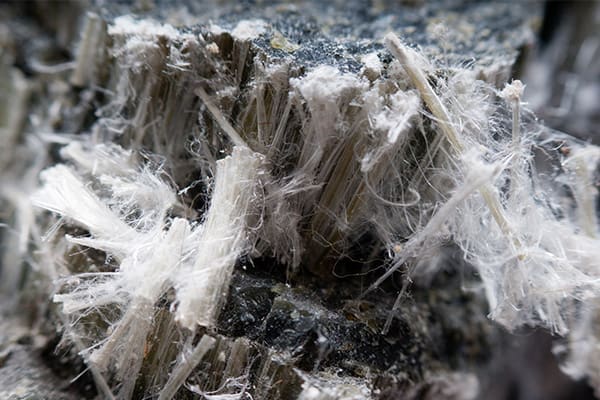
Asbestos is a group of naturally occurring minerals often used in construction and manufacturing. There are 6 types of asbestos, with chrysotile, amosite and crocidolite being the three most commonly used.
Chrysotile, also known as “white asbestos,” has been more popular than other types because it’s abundant, affordable, flexible and some believed it to be less harmful. In 1973, United States asbestos consumption peaked at 803,000 tons. Much of this asbestos was in chrysotile form. In 2024, the total consumption was 110 tons, all of it chrysotile.
Keep reading to learn more about why chrysotile became the most widely used asbestos type and how its properties set it apart.
4 Reasons Why Chrysotile Asbestos Was So Popular
Chrysotile was the most commonly used asbestos type because of its unique properties, including heat and fire resistance, durability and flexibility. Its soft, flexible fibers made it easier to work with in various materials – unlike amphibole asbestos with its stiff, needle-like fibers.
Each type of asbestos belongs to one of two mineral families: serpentine or amphibole. Chrysotile is the only serpentine type. The others are all amphibole types.
While all types of asbestos are hazardous, some people viewed chrysotile as less harmful than others. This belief is unsupported by current science.
These factors made chrysotile the preferred type of asbestos in construction and industry.
1: Availability and Affordability
Asbestos can be found around the world. The mineral forms naturally in rock, with chrysotile asbestos being the most common. Because chrysotile is so plentiful, industries found it easier to get and cheaper to use than other minerals with similar qualities.
In the United States, the Appalachian Mountains have large chrysotile deposits. Chrysotile can also be found in belts extending from Maine to Alabama and from Washington to California.
Chrysotile’s affordability contributed to its widespread use in homes, offices, public buildings and consumer products. The mineral was added to ceiling tiles, drywall, flooring and insulation, as well as household items like ironing board covers and oven mitts.
2: Easier to Work With
Chrysotile was the easiest asbestos type to work with because it is the softest and most flexible. Asbestos fibers are categorized as short, medium and long. Each size category has different properties.
Chrysotile asbestos has long, curly, pliable fibers. Unlike the brittle, needle-like fibers of other types, chrysotile fibers can bend and weave without breaking.
The length and flexibility of this asbestos type allowed it to blend easily with building materials like cement, plastics and resins. Chrysotile was also used as a loose fiber mixture and woven into fabrics.
These unique properties made chrysotile asbestos the best fit for various products, including:
3: Durability and Heat Resistance
Chrysotile asbestos was valued for its resistance to heat and fire, making it a popular choice for fireproofing and insulation. Its fibers could withstand high temperatures without breaking down, so industries relied on it for high-heat environments.
In construction, chrysotile asbestos was used in roofing, cement and insulation to help prevent fires. The automotive industry used the mineral in brake pads and clutches to reduce wear. Manufacturers favored chrysotile because its flexible fibers mixed easily into products without falling apart.
Many industries took advantage of chrysotile asbestos for its durability and affordability. Since the mineral was widely available and inexpensive, businesses could produce fire-resistant materials at lower costs.
Beyond construction and automotive uses, chrysotile played a role in protective equipment. The textile industry wove its heat-resistant fibers into fireproof fabrics for safety gear. Firefighters, tradespeople and other workers in high-heat settings depended on asbestos-lined gloves, jackets and blankets for protection.
4: Supposed Safety
Industries long pointed to scientific evidence suggesting chrysotile asbestos was less harmful than other types. Early research suggested the curly, flexible fibers of chrysotile asbestos were less likely to get stuck in the lungs. Later studies questioned these conclusions, calling for more thorough research.
All asbestos types are now recognized as dangerous to human health. Scientists have conclusively linked asbestos exposure to mesothelioma and lung cancer.
Is Chrysotile Asbestos Banned in the United States?
In December 2020, the Environmental Protection Agency (EPA) completed its review of chrysotile asbestos and confirmed that it poses a serious health risk. To address this, the EPA issued a rule in March 2024 banning its continued use. The ruling set deadlines for industries to phase out chrysotile asbestos to help protect people from various cancers and other diseases.
For many years, chrysotile was the most widely used asbestos type. Over time, research has shown that no form of asbestos is safe, and chrysotile is recognized as a major health threat. Sixty-eight countries have banned it completely, while others have imposed strict regulations. As awareness has grown, industries have shifted to safer alternatives.


Sources
Ameille J, Rosenberg N, Matrat M, Descatha A, Mompoint D, Hamzi L, et al. Asbestos-related diseases in automobile mechanics. Ann Occup Hyg. 2012 Jan;56(1):55–60.
Baur X, Frank AL. Ongoing downplaying of the carcinogenicity of chrysotile asbestos by vested interests. J Occup Med Toxicol. 2021 Feb 23;16(1):6.
Bernstein D, Dunnigan J, Hesterberg T, Brown R, Velasco JAL, Barrera R, et al. Health risk of chrysotile revisited. Crit Rev Toxicol. 2013 Feb;43(2):154–83.
Cherrie JW, Tindall M, Cowie H. Exposure and risks from wearing asbestos mitts. Part Fibre Toxicol. 2005 Oct 3;2:5.
International Agency for Research on Cancer. ASBESTOS (CHRYSOTILE, AMOSITE, CROCIDOLITE, TREMOLITE, ACTINOLITE AND ANTHOPHYLLITE).
StatPearls. Asbestosis.
Tse LA, Yu IT sun, Goggins W, Clements M, Wang XR, Au JS kie, et al. Are current or future mesothelioma epidemics in Hong Kong the tragic legacy of uncontrolled use of asbestos in the past? Environ Health Perspect. 2010 Mar;118(3):382–6.
United States Geological Survey. Asbestos in the United States, exclusive of Alaska and Hawaii.
World Health Organization. Chrysotile Asbestos.
Yano E, Wang ZM, Wang XR, Wang MZ, Takata A, Kohyama N, et al. Mesothelioma in a worker who spun chrysotile asbestos at home during childhood. Am J Ind Med. 2009 Apr;52(4):282–7.
Free Mesothelioma Treatment Guide

Tara Strand specializes in writing content about mesothelioma and asbestos. She focuses on topics like mesothelioma awareness, research, treatment, asbestos trust funds and other advocacy efforts.