Asbestos on Destroyer Escorts

Destroyer escorts were small warships built during World War II to protect convoys. They are no longer in service. Famous ships like the USS Slater served in major conflicts. These vessels often had asbestos. This put sailors and workers at risk for mesothelioma.
Learn About Asbestos Exposure on Navy Ships in Our Free Guide
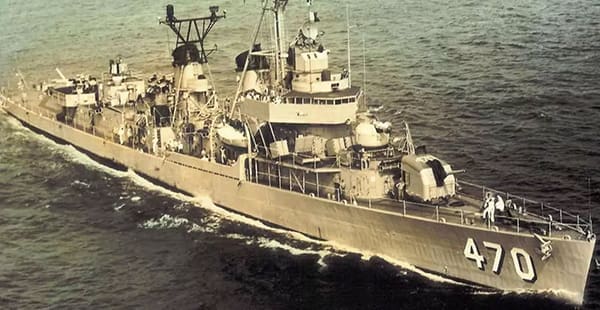
History of Destroyer Escorts
Destroyer escorts (DEs) were small warships built by the United States and its allies during World War II (WWII). They mostly guarded convoys of merchant ships and warships from enemy vessels, but also supplied some protection against enemy planes. Before DEs, many merchant ships were targets for German and Japanese submarines.
The U.S. Navy launched the first destroyer escorts in 1943. They were faster and easier to build than bigger destroyers. In total, the Navy commissioned over 500 DEs by the end of the war. They had guns, depth charges and sonar to hunt submarines.
During WWII, destroyer escorts formed hunter-killer groups that tracked down and sank enemy submarines. They played a pivotal role in winning the Battle of the Atlantic. One DE, the USS England, sank six Japanese submarines in 12 days in 1944.
After the war, the Navy retired many DEs, sold them to allied navies or converted them for other uses. Some still served during the Korean War and later in the Cold War. Some destroyer escorts were later reclassified as DER (Radar Picket) or DEG (Guided Missile) ships. By the mid-1960s, the Navy had removed most WWII-era destroyer escorts from active duty.
The USS Parle was the last to serve. The Navy decommissioned the vessel in 1970. Today, two DEs still exist as museum ships: the USS Slater in Albany, New York, and the USS Stewart in Galveston, Texas.
Many destroyer escorts had asbestos on board. Shipbuilders used the mineral for insulation and fireproofing. As a result, many sailors on DEs came into contact with asbestos, which could later cause serious health problems.
Destroyer Escorts’ History at a Glance
- Other Names/Classes: Buckley, Cannon, Claud Jones, Dealey, Edsall, Evarts, John C. Butler, Rudderow
- Years of Operation: 1943 – 1970
- Wartime Operations: Cold War, Korean War, Vietnam War, World War II (WWII)
- Size of Crew: Roughly 200 people
- Size of Ship: About 300 to 306 feet long
- Noteworthy Ships: USS Dennis, USS John C. Butler, USS Raymond, USS Samuel B. Roberts, USS Slater
Notable Destroyer Escorts
Destroyer escorts were an important part of the U.S. Navy’s fleet. They helped protect larger ships and merchant convoys during major wars. Like most naval ships, these vessels used asbestos products to protect against heat and fire, which put many sailors at risk.
These ships often carried large crews and operated in active war zones. Some became known for their specific missions and service records, including the USS Samuel B. Roberts and the USS Slater.
USS Samuel B. Roberts (DE-413)
The USS Samuel B. Roberts (DE-413) was a John C. Butler-class destroyer escort commissioned in 1944. During its service, the ship carried about 215 crew members and operated out of places like Boston, Pearl Harbor and the Panama Canal. For its actions, it earned one battle star and a Presidential Unit Citation.
The ship became well-known for its role in the Battle of Samar during WWII. In October 1944, the ship joined other destroyers and DEs to defend American escort carriers from a much larger Japanese force. Outnumbered and outgunned, the USS Samuel B. Roberts took the lead and protected the fleet. Its actions helped stop the attack but left the ship damaged.
The Roberts eventually sank, but the Battle of Samar earned it the nickname “the destroyer escort that fought like a battleship.” It is still seen as one of the most notable stands in naval history and is studied at military schools today.
Like many ships from this period, the USS Samuel B. Roberts likely contained large quantities of asbestos. Shipbuilders often used the mineral in insulation around boiler rooms, engine spaces and steam lines.
USS Slater (DE-766)
The USS Slater (DE-766) is a Cannon-class destroyer escort launched in 1944. The Navy built it to guard convoys from enemy submarines in the Atlantic. During its service, the ship carried about 216 crew members and took on missions in Key West, San Diego and many other locations. The Navy decommissioned the USS Slater in May 1947.
In 2012, the U.S. Department of the Interior (DOI) named it a National Historic Landmark. Today, the USS Slater is fully restored and serves as a floating museum in Albany, New York. Visitors can walk through its passageways and learn about its naval service.
The Navy used asbestos in many shipbuilding and repair jobs. The USS Slater likely contained the mineral as well. This widespread use on ships may have caused significant asbestos exposure for sailors and shipyard workers.
 Did You Know?
Asbestos exposure is still responsible for thousands of deaths each year.
Victims of asbestos exposure who have been diagnosed with mesothelioma may be eligible for financial compensation.
Did You Know?
Asbestos exposure is still responsible for thousands of deaths each year.
Victims of asbestos exposure who have been diagnosed with mesothelioma may be eligible for financial compensation.
Complete List of Destroyer Escorts
In late 1941, the U.S. Navy had more than 500 destroyer escorts made across six different classes. Shipbuilders used asbestos-based products on each to help protect against fires and overheating. The table below is a complete list of destroyer escorts.
Asbestos Use on Destroyer Escorts
Asbestos materials were commonly used on destroyer escorts built during WWII and could be found throughout the ship. They wrapped steam pipes, covered boilers and lined engine rooms. These materials exposed sailors and shipyard workers to serious health risks, including mesothelioma.
Common asbestos-containing products found on destroyer escorts included:
- Adhesives
- Boilers
- Building materials
- Cement
- Deck and floor tiles
- Electrical panels
- Fireproofing materials
- Gaskets
- Insulation
- Lagging
- Packing
- Pump systems
- Ropes
- Turbines
- Valves
- Wiring
When these materials were cut, damaged or worn down, they could release tiny asbestos fibers into the air. Crew members might have breathed in these fibers without knowing the danger.
Who Was at Risk of Asbestos Exposure on Destroyer Escorts?
Sailors on destroyer escorts and the workers at shipyards who built or fixed them faced asbestos risks. Ship systems used asbestos in many places, so people in almost any trade could come into contact with it. Those at highest risk included dockyard crews, engine and mechanical workers and electrical teams. Maintenance staff and people in structural trades were also often exposed.
People in these roles were especially at risk of occupational asbestos exposure, including:
- Boilermakers
- Boiler tenders
- Caulkers
- Chippers
- Construction workers
- Electricians
- Hull maintenance technicians
- Insulators
- Laggers
- Machinists
- Maintenance and repair workers
- Mechanics
- Painters
- Pipefitters
- Plumbers
- Radiomen
- Riveters
- Seabees
- Sheet metal workers
- Shipfitters
- Shipyard workers
- Steamfitters
- Tile setters
- Toolmakers
- Veterans
- Welders
In 2021, researchers looked at health records from about 5,000 Navy veterans. Sailors who spent more time aboard ships were found to have higher rates of asbestos-related diseases. Risk increased with time spent at sea. The engineering crew had the highest rates of lung problems and scarring.
Compensation for People Exposed on Destroyer Escorts
Navy veterans with mesothelioma or similar diseases may file lawsuits against companies that made asbestos products used on ships. These legal claims can result in compensation for medical costs and lost income.
If a company responsible for asbestos exposure has gone through bankruptcy, it may have established an asbestos trust fund. These trusts were created to compensate people harmed by the company’s products and may be an option for veterans who cannot file a traditional lawsuit.
Veterans who developed asbestos diseases after serving on destroyer escorts may also qualify for benefits through the U.S. Department of Veterans Affairs (VA). These benefits can help pay for healthcare, disability and family support.
Veterans and their families can learn more by speaking with experienced mesothelioma lawyers or VA advisors. Lawyers can help review legal options, assist with VA forms and manage lawsuits. VA advisors can explain benefits and help gather the records needed to file a claim.
Sources
American Legion. DESTROYER ESCORT SAILORS ASSOCIATION AND THE USS SLATER DE766.
Asbestos Ships. USS Samuel B. Roberts (DE-413) Areas With Asbestos Exposure.
Asbestos Ships. USS Slater (DE-766) Areas With Asbestos Exposure.
Destroyer History Foundation. APD Conversions.
Destroyer History Foundation. Buckley Class.
Destroyer History Foundation. Destroyer Escorts.
Lemen RA, Landrigan PJ. Sailors and the risk of asbestos-related cancer. Int J Environ Res Public Health. 2021 Aug 9;18(16):8417.
National Museum of the U.S. Navy. Rudderow-class destroyer escorts.
National Park Service. Destroyer Escorts.
Naval Historical Foundation. POST WORLD WAR II DESTROYER ESCORTS.
Naval History and Heritage Command. Samuel B. Roberts I (DE-413).
USS Kendall C. Campbell. Destroyer Escort History.
USS Slater. CLASSES OF DESTROYER ESCORTS.
USS Slater. DE’s IN THE PACIFIC.
USS Slater. HISTORY OF DESTROYER ESCORTS.
USS Slater. SLATER OVERVIEW.
USS Slater. SLATER’S WAR RECORD.
Warfare History Network. Holding the Line on the High Seas.
Legal Rights for Mesothelioma Victims

Tara Strand specializes in writing content about mesothelioma and asbestos. She focuses on topics like mesothelioma awareness, research, treatment, asbestos trust funds and other advocacy efforts.

 Legally
Reviewed by
Jennifer Lucarelli
Mesothelioma Lawyer and Legal Advisor
Legally
Reviewed by
Jennifer Lucarelli
Mesothelioma Lawyer and Legal Advisor
For more than two decades, Jennifer Lucarelli has served as Legal Advisor at Mesothelioma.com. She has advocated for more than 1,000 asbestos victims, securing millions in settlements and helping them access quality medical care.