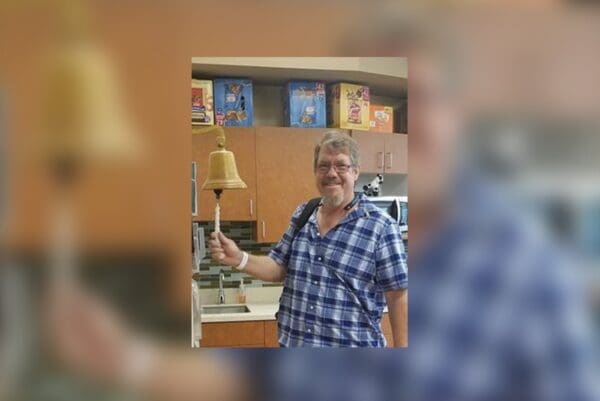
Editor’s Note: This survivor story was originally published in 2019 and has been updated in memory of Jim Dykstra, who passed away in July 2026. Some treatment details reflect Jim’s circumstances at the time of his original interview.
Jim Dykstra lived with peritoneal mesothelioma for more than a decade after his diagnosis in 2013. During that time, he shared his experiences to educate and encourage other people affected by this rare cancer.
Before his passing, Jim spoke with Mesothelioma.com about his occupational asbestos exposure, treatment journey and the outlook that helped him move forward. His resilience, sense of humor and message that no one faces mesothelioma alone remain part of his legacy.
Jim had a successful 26-year career working in the HVAC field for the city of Phoenix. Stationed at Phoenix Sky Harbor International Airport, he frequently maintained boilers and other building systems. Jim later learned that this work had exposed him to asbestos in the buildings and products he handled.
After Jim was diagnosed with testicular cancer in 2011, a CT scan revealed growths in his abdomen. He was diagnosed with peritoneal mesothelioma in 2013 and underwent several forms of treatment during the years that followed.
A History of Asbestos Exposure
Jim grew up in a military family and moved frequently before settling in Phoenix, Arizona. As an adult, he began a career in the HVAC industry and worked at Phoenix Sky Harbor International Airport.
“While there, I worked within buildings that were full of asbestos but was unaware of that. In Terminal 2, there were two Cleaver-Brooks Boilers that required refactoring periodically, which as a worker I did as assigned,” Jim told Mesothelioma.com. “Terminals 1 and 2 had asbestos all over the place and have had abatement done to them. Terminal 1 was torn down in the late 1980s to the early 1990s.”
Jim said asbestos was also present in other areas of the airport.
“There is a red brick building called FAA North that they had to move all the functions to a new building due to the extensive amount of asbestos,” he said. “Afterwards, the city just closed the building and wouldn’t allow anyone to enter.”
Jim was unaware of the asbestos around him while performing his job. Like many workers exposed decades ago, he learned about the potential danger only after developing an asbestos-related disease.
Receiving the Mesothelioma Diagnosis
Jim underwent a routine CT scan about a year and a half after receiving treatment for testicular cancer. The scan revealed growths in his abdomen. His oncologist initially monitored the growths, but additional scans showed that they had increased in number and size.
“My doctor went three months for another scan and, you guessed it, there were more of the tumors and the older ones were bigger,” Jim recalled.
In July 2013, Jim underwent a CT-guided biopsy to determine what was causing the growths. However, the medical team had difficulty obtaining a tissue sample.
“The surgeon tried seven times in and out of the machine, and finally he gave up, stating, ‘It’s like hitting a superball in jello,’” Jim said.
Jim returned for another biopsy in August. This time, the surgeon successfully collected two tissue samples.
Jim and his wife later learned that he had epithelioid peritoneal mesothelioma. Peritoneal mesothelioma develops in the lining of the abdomen. The epithelioid cell type generally responds more favorably to treatment than other mesothelioma cell types.
Jim’s Mesothelioma Treatment Journey
After his diagnosis, Jim’s doctors explained his best treatment option would be to undergo cytoreductive surgery followed by hyperthermic intraperitoneal chemotherapy (HIPEC). This treatment works by first removing all visible tumors and then circulating a heated chemotherapy wash throughout the abdomen to kill any remaining cancer.
After he recovered, Jim next underwent 30 sessions of radiation therapy for the tumors the doctors were unable to remove in the liver. Shortly afterward, he underwent four cycles of chemotherapy, which consisted of cisplatin and pemetrexed (Alimta®), followed by another two cycles of carboplatin and Alimta. He finished these rounds of treatment in June 2014.
“Afterwards, I went back to my original oncologist who was testing me with the SMRP blood test. All was good until late 2018, when my SMRP blood test showed an increase in numbers from 0.9 to 1.4. That is when PET scan showed new growth, and in May I started back with chemotherapy,” Jim told Mesothelioma.com.
Jim resumed chemotherapy with carboplatin, pemetrexed and bevacizumab, also known by the brand name Avastin®. His treatment was later adjusted to pemetrexed and bevacizumab.
Two tumors did not respond to the treatment and could not be removed surgically. His oncologist recommended cryoablation to treat the tumors in his liver. Jim underwent the procedure successfully in October 2018.
Jim later began immunotherapy with pembrolizumab, also known by the brand name Keytruda®. At the time of his 2019 interview, he was continuing to receive the treatment. Jim also said his tumors had tested positive for a BRCA2 mutation, which could have helped his doctors identify other potential treatment options.
When Jim’s cancer returned again in 2020, he underwent another cytoreductive surgery with HIPEC. His difficult recovery included a pancreatic infection, but Jim continued looking for positive ways to move forward.
Jim was then able to start undergoing immunotherapy treatment with Keytruda®, which he is still being treated with today. If the Keytruda should stop working, Jim explained that his tumors are positive with the BRCA-2 mutation, which opens the doors for several other experimental drugs. Most recently, the FDA-approved NovoTTF-100L could be a potential option for Jim, when the FDA removes the freeze on it and allows patients to use it for peritoneal mesothelioma.
Jim’s Advice to Other Mesothelioma Patients
Throughout his experience with mesothelioma, Jim emphasized the importance of humor, trusted medical care and support from loved ones. He shared the following advice with other patients:
- Have a good frame of mind always. Don’t allow yourself to get into “the dark funk.”
- Always have a sense of humor. I say, “I have to have humor because I already have a tumor.”
- Trust in your doctor. If not, find another one.
- Have faith in God or whoever is your spiritual guidance, family, friends and most importantly, yourself.
- Lastly, be strong and remember you are not alone in this fight.”
Jim’s sense of humor remained an important source of strength.
“I have to have humor because I already have a tumor,” he said.
He concluded his advice with a message that continues to offer encouragement to patients and families:
“Be strong and remember you are not alone in this fight.”
Jim has since passed away, but his strength, humor and willingness to share his experiences remain a meaningful part of his legacy. Mesothelioma.com extends its heartfelt condolences to Jim’s family, friends and everyone whose life he touched.


Free Mesothelioma Treatment Guide